Expert analysis of Albrecht Durer’s Scheibenriß Tafelnde society and death
Style: Northern Renaissance · Genre: allegorical painting
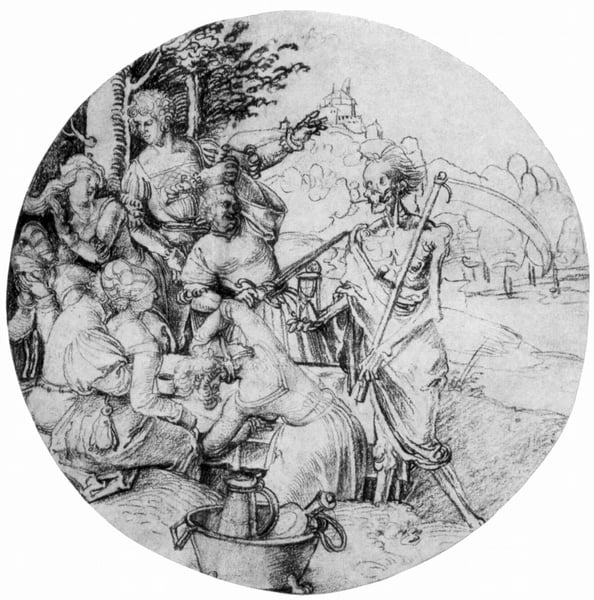
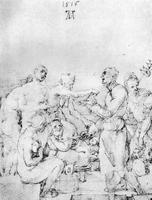
Albrecht Dürer’s "Scheibenriß Tafelnde society and death" (circa 1485–1500) is a masterful allegorical drawing from the Northern Renaissance, likely a design for a stained-glass roundel (hence “Scheibenriß”). Its significance lies in how Dürer synthesizes late Gothic meticulousness with Renaissance humanist moralizing, creating a vivid memento mori that critiques worldly pleasure.
Stylistic Significance
Dürer’s sharp, precise linework—characteristic of his early studies—captures both the lavish textures of feasting cloths and dishes and the skeletal starkness of Death. This contrast embodies the Northern Renaissance obsession with surface realism as a vehicle for symbolic meaning. Unlike Italian allegories that often idealize, Dürer’s figures are earthy, individualized, and grotesque in their revelry, pushing the viewer toward introspection.
Allegorical Genius
The scene depicts a boisterous banquet (“Tafelnde society”) suddenly intruded upon by Death—a grinning skeleton or cadaver, often holding an hourglass or scythe. This is a direct visual sermon on the transience of life, echoing the Dance of Death tradition popular in German art. Dürer elevates the motif by placing it in a contemporary, identifiable setting: the viewer’s own society is condemned. The sin of gluttony, pride, and obliviousness to mortality is laid bare, making the allegory urgent and didactic.
Historical Context
As an early work, it foreshadows Dürer’s later masterpieces of moral complexity (e.g., Melencolia I). Here, he already demonstrates his genius for combining hyper-realistic observation with dense symbolic layers, a hallmark that distinguishes Northern Renaissance allegory from its more secular Italian counterparts. The piece endures as a powerful snapshot of Dürer’s critical eye on human folly—and death’s uninvited seat at every table.
Museum / Gallery
Visually similar
20 works with related composition and palette
A Scene of Exodus with Women and Children Resting
Adam van Noort
Betrayal Of Christ
Albrecht Durer
Women only
Albrecht Durer
Christ on the Mount of Olives
Albrecht Durer
Reineke Fuchs1
Wilhelm von Kaulbach
Orpheus Slain By Bacchantes, With A Boy Running Away
Albrecht Durer
Hey! Come hither
Arthur Rackham
The Mocking of Christ
Albrecht Durer
Apollo and the Nine Muses Surrounded by Poets on Mount Parnassus
Karel Škréta
Naissance d'Adonis
Francesco de' Rossi (Francesco Salviati), "Cecchino"
Christ in Limbo
Albrecht Durer
The Adoration of the Shepherds
Cornelis Cort
Christ on the Mount of Olives
Albrecht Durer
Christ Appears to Mary Magdalene
Albrecht Durer
Christ on the Mount of Olives
Albrecht Durer
Deposition (Engraved Passion)
Albrecht Durer
La cacciata dei mercanti dal tempio
Giulio Benso
Meeting of Moses and Jethro
Willem van Swanenburg
The Adoration of the Shepherds
Carlo Urbino
Apparition of the Angels to Abraham, from L Carracci
Giovanni Battista Piranesi