Expert analysis of Albrecht Durer’s Study Journal, naked couple and the Devil
Style: Northern Renaissance · Genre: sketch and study
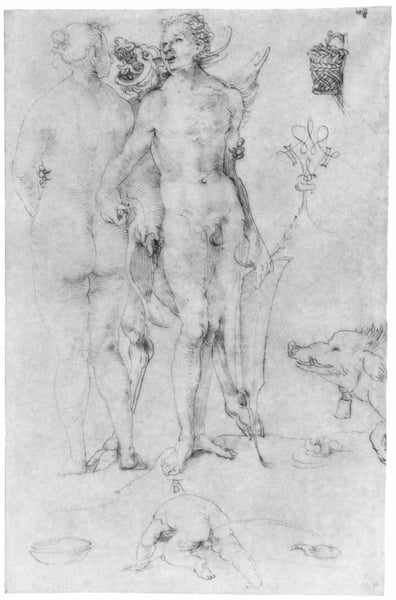
This sketch—Study Journal, naked couple and the Devil—is a remarkable window into Albrecht Dürer’s working process and the intellectual currents of the Northern Renaissance. As a sketch and study, it holds significance not as a finished masterpiece, but as a direct, unpolished record of Dürer’s meticulous observation and his engagement with moral allegory.
Technical Significance:
Dürer elevated the status of the preparatory drawing from a mere tool to a work of art in its own right. Here, his precise, hatched lines and careful modelling of the human form—especially the anatomical rendering of the couple—demonstrate his pioneering absorption of Italian Renaissance ideals of proportion and perspective, filtered through a distinctly Northern sensitivity to detail. The sketch’s loose, exploratory quality reveals Dürer’s process of working out composition and meaning directly on the page.
Iconographic Significance:
The inclusion of the Devil alongside a naked couple immediately plants the work in the Northern Renaissance tradition of moralizing allegory. The temptations of the flesh, the fragility of human virtue, and the lurking presence of sin were common themes in Dürer’s era. What makes this study notable is the candid, almost vulnerable depiction of the couple—they are not idealized nudes but specific, observed bodies. The Devil, by contrast, is likely rendered with grotesque, fantastical features, contrasting human realism with infernal caricature. This juxtaposition underscores Dürer’s ability to merge naturalism with symbolic storytelling, a hallmark of his genius.
Historical Significance:
As a study in a journal, this work connects Dürer to the broader Renaissance culture of the libro di disegni (book of drawings), where artists compiled observations, inventions, and experiments. It provides invaluable insight into how Dürer prepared for larger, more polished works—such as his famous engravings like Adam and Eve or The Knight, Death, and the Devil—and shows his unbroken curiosity about the human condition, even in its most private and vulnerable moments.
In summary, this sketch is significant because it captures Dürer at his most direct: a Northern Renaissance master fusing Italianate humanism with Northern moral gravity, using a simple study to explore the eternal tension between flesh and spirit.
Museum / Gallery
Visually similar
20 works with related composition and palette
Allegory of Time and Art
Bartholomeus Spranger
Study for The Golden Age
Jean Auguste Dominique Ingres
The Original Sin (Adam and Eve)
Bartholomeus Spranger
Study for the Kneeling Leda
Leonardo da Vinci
The Three Graces
Jacopo Pontormo
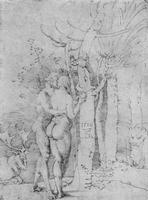
Adam and Eve
Albrecht Durer
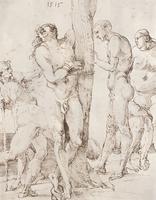
Study sheet with six nude figures
Albrecht Durer
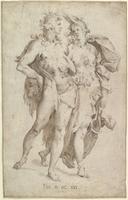
Ceres and Bacchus
Bartholomeus Spranger
Various studies
Michelangelo
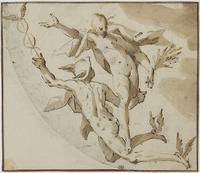
Mercury and Ceres flying through the air
Hans von Aachen
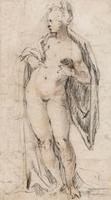
Study of a Female Nude (Venus in a Drapery)
Bartholomeus Spranger
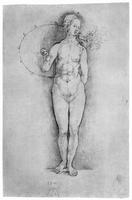
Female Nude
Albrecht Durer
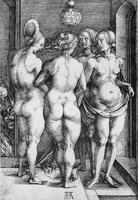
The Four Witches
Albrecht Durer
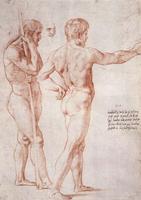
Nude Study
Raphael
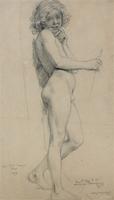
Shepherd (study for The Golden Age at the Musée du Luxembourg)
Diogène Maillart
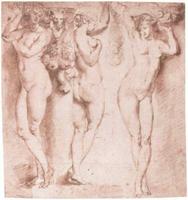
The Three Caryatids
Peter Paul Rubens
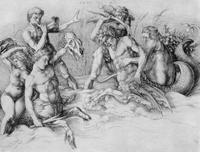
Fighting Seekentauren
Albrecht Durer
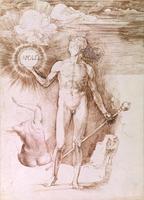
Apollo
Albrecht Durer
Nude Study (Nude Female from the Back)
Albrecht Durer
Glaucus and Scylla
Salvator Rosa