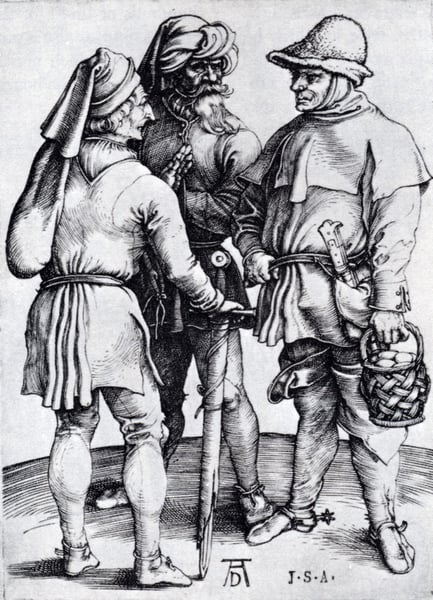
Albrecht Durer sanatçısının Three Peasants In Conversation eseri hakkında uzman analizi
Tarz: Northern Renaissance · Tür: genre painting
Expert Art Historical Analysis: Three Peasants In Conversation by Albrecht Dürer
Style & Context:
Albrecht Dürer (1471–1528) stands as the towering figure of the Northern Renaissance, a period defined by an unprecedented fusion of Italian Renaissance ideals—perspective, proportion, and classical balance—with the meticulous, empirical naturalism of Northern European painting and printmaking. This work belongs to the genre painting tradition, a category that emerged during the Renaissance to depict scenes of everyday life, often with moral, satirical, or humanist undertones. In Dürer’s hands, a seemingly simple moment of three peasants talking becomes a masterclass in observation and social commentary.
Subject & Composition:
The artwork captures three rustic figures engaged in animated conversation. Dürer’s choice of peasants—rather than nobility or biblical figures—signals a significant shift in Renaissance art: the elevation of common humanity as worthy subject matter. Each figure is rendered with individual character: the postures, facial expressions, and loosely gathered clothing convey a sense of shared gossip or debate. The composition is compact, bringing the viewer into close proximity with the trio, emphasizing their rough-hewn features and weathered hands—details that Dürer observed with scientific precision.
Significance within the Northern Renaissance:
This work is significant for several reasons:
-
Mastery of Naturalism & Texture: Dürer’s unparalleled engraving or painting technique (depending on the medium—more likely an engraving or drawing given his fame for printmaking) reveals every wrinkle, strand of hair, and fold of coarse fabric. This obsessive attention to texture and surface detail is a hallmark of Northern Renaissance art, rooted in the tradition of Jan van Eyck and Rogier van der Weyden. Dürer elevates the mundane—a peasant’s tunic, a knotted hand—to a level of dignity and visual delight.
-
Humanist Empathy: Unlike earlier medieval portrayals of peasants as caricatures or laborers in the background, Dürer treats them as individuals with agency and inner life. Their conversation implies intellect, emotion, and social connection. This aligns with the Northern Renaissance’s embrace of humanism, which sought to understand human experience in all its forms, from the princely to the plebeian.
-
Social Documentation: As a genre scene, the work serves as a visual record of 16th-century German rural life. Dürer’s contemporaries, such as Pieter Bruegel the Elder, would later expand this tradition, but Dürer’s early engagement with peasant life paved the way for a new artistic language that valued the everyday as a lens for moral and cultural insight.
-
Compositional Balance & Character: Despite the roughness of the subject, Dürer applies a rigorous sense of design. The triangular composition of the three figures suggests stability and dialogue. Each gaze and gesture creates a dynamic exchange, making the scene feel arrested in time—a moment of genuine human connection.
Conclusion:
Three Peasants In Conversation is a testament to Dürer’s ability to find profound significance in the ordinary. It exemplifies the Northern Renaissance’s hunger for verisimilitude, its curiosity about the lives of all social classes, and its belief that even the simplest act—a conversation—merits the highest artistic craftsmanship. Through this work, Dürer not only documents a fleeting social encounter but also affirms the dignity of labor and the universal nature of human dialogue, securing its place as a cornerstone of early modern genre painting.
Museum / Gallery
Görsel olarak benzer
İlişkili kompozisyon ve renk paletine sahip 20 eser
A peasant and three bustlength figures
Hieronymus Bosch
Rustic Couple
Albrecht Durer
Otto of the Silver Hand 30
Howard Pyle
The ship of fool
Albrecht Durer
The young peasant and his wife
Albrecht Durer
Jacques de Caumont
Frederick Sandys
Virgil in The Basket
Lucas van Leyden
The Mocking of Christ
Albrecht Durer
Christ before Herod
Albrecht Durer
Christ Before Pilate
Albrecht Durer
Burning of William White, a Priest, Norwich, England, AD 1428
Jan Luyken
Soldiers
Albrecht Durer
Pilate Washing His Hands
Albrecht Durer
Christ before Annas
Albrecht Durer
A Beggar and a Companion Piece, Turned to the Left
Rembrandt
A Turkish Janissary
Gentile Bellini
Five Lansquenets And An Oriental On Horseback
Albrecht Durer
Don Quixote
Gustave Dore
Group of Male Figures
Hieronymus Bosch
The Cook And His Wife
Albrecht Durer