
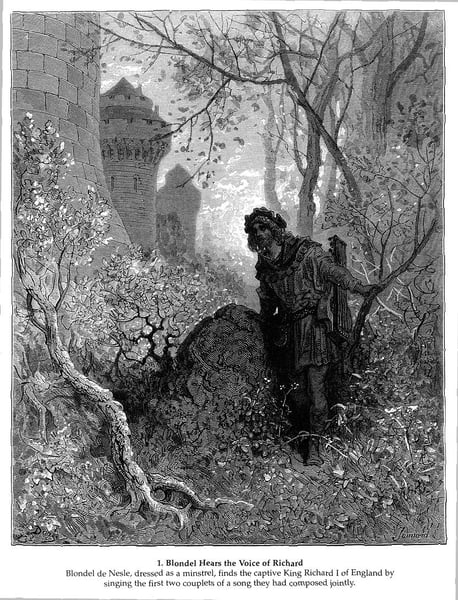
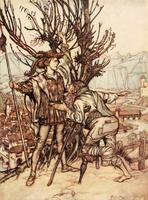
Blondel hears the voice of Richard the Lionheart
Details
Expertenanalyse zu Gustave Dores Blondel hears the voice of Richard the Lionheart
Stil: Romanticism · Genre: illustration
Based on the structured facts provided—Artwork: "Blondel hears the voice of Richard the Lionheart" by Gustave Doré, Style: Romanticism, Genre: illustration—here is an expert analysis focusing on its significance:
Expert Analysis
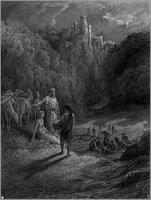
Gustave Doré’s Blondel hears the voice of Richard the Lionheart stands as a quintessential example of Romantic illustration, where dramatic narrative, emotional intensity, and a deep engagement with medieval legend converge. The work derives its power from Doré’s ability to transform a historical-mythical episode into a visually arresting moment of longing and recognition.
The Subject and Its Romantic Appeal
The legend tells of the troubadour Blondel de Nesle searching for his imprisoned king, Richard I, during the Third Crusade. Upon hearing Richard’s song from a castle window, Blondel identifies the king’s location—a tale of loyalty, music, and the unbreakable bond between ruler and poet. For Romanticism, this story offered rich terrain: individualism, medievalism, and the triumph of emotion over rational constraint. Doré captures the exact instant when Blondel, leaning forward with rapt attention, hears the faint melody—a moment suspended between doubt and certainty.
Doré’s Illustrative Genius
Though classified as an illustration, Doré elevates the genre to high art. His composition channels Romantic tropes: dramatic chiaroscuro (light from an unseen source illuminates Blondel’s face, while the castle and surroundings dissolve into deep shadow), a sense of isolation and scale (the vast, rugged landscape dwarfs the figure), and meticulous attention to period detail (armor, architecture, and the troubadour’s lute). The Gothic ruins and jagged rocks evoke both physical and emotional barriers, while the diagonal line of Blondel’s body and the castle towers creates a dynamic, tension-filled vector.
Significance within Romanticism and Illustration
Doré’s work is significant because it synthesizes the Romantic preoccupation with the sublime—the mixture of awe and terror before nature’s grandeur—with the narrative precision of book illustration. Here, the sublime is not found in a storm or mountain but in the psychological landscape of hope and despair. The image functions as both a standalone masterpiece and a pivotal moment in a larger story, demonstrating how illustration can achieve the same emotional depth as history painting.
Moreover, Doré’s technique in this piece—cross-hatching, atmospheric texture, and selective focus—became highly influential in later graphic arts, from wood engraving to comic book storytelling. His ability to make a static image thrum with auditory memory (the unseen song) exemplifies Romanticism’s drive to engage all the senses through visual means.
Conclusion
Blondel hears the voice of Richard the Lionheart is significant as a perfect Fusion of Romantic ideals—medieval chivalry, emotional communion, and the heroic individual—with the craft of illustration. It proves that the illustrative genre can carry the same weight as any academic painting, capturing a fleeting, pivotal instant that resonates with the Romantic soul. Doré not only illustrates a story; he makes the viewer hear the long-awaited voice.
Museum / Gallery
Visuell ähnlich
20 Werke mit ähnlicher Komposition und Farbpalette
Bohemond alone mounts the rampart of antioch crusades bohemond mounts rampart of antioch
Gustave Dore
Geraint and Enid Ride Away
Gustave Dore
Benediction
Gustave Dore
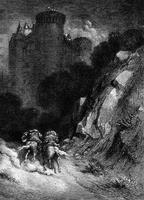
Heaven Be Praised, They Are My Brothers!
Gustave Dore
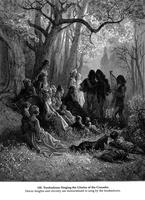
Troubadours Singing the Glories of the Crusades
Gustave Dore
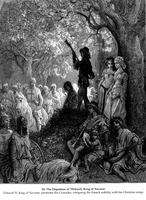
The Departure of Thibault, King of Navarre
Gustave Dore
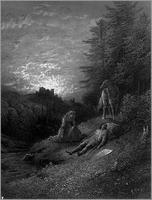
Idylls of the King
Gustave Dore
Don Quixote
Gustave Dore
The Betrayal of Judas
Ivan Aivazovsky
Don Quixote
Gustave Dore
A Message from the East
Gustave Dore
The Iron Age
Georg Andreas Wolffgang the elder
Idylls of the King
Gustave Dore
The rat poison peddler (The rat catcher)
Rembrandt
Second assault of Jerusalem by the Crusaders repulsed
Gustave Dore
Burning of 180 Albigensians, AD 1210
Jan Luyken
Donkeyskin
Gustave Dore
The Return
Gustave Dore
River Valley with Church Ruin and Staffage Figures
Christian Georg Schutz the elder
The young Prince said, ‘I am not afraid; I am determined to go and look upon the lovely Briar Rose’
Arthur Rackham