
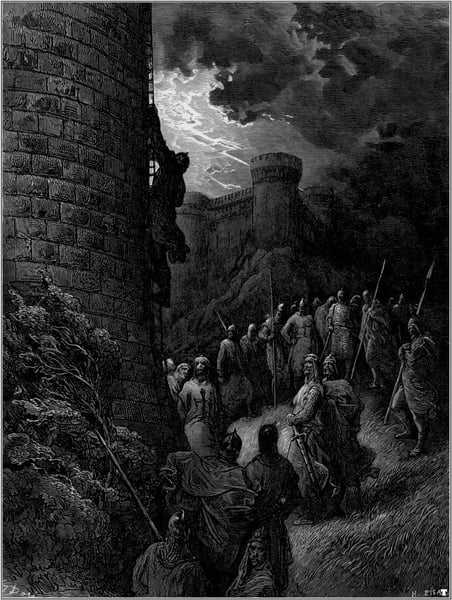
Bohemond alone mounts the rampart of antioch crusades bohemond mounts rampart of antioch
Dettagli
Analisi esperta di Bohemond alone mounts the rampart of antioch crusades bohemond mounts rampart of antioch di Gustave Dore
Stile: Romanticism · Genere: illustration
This artwork, an illustration by Gustave Doré titled Bohemond alone mounts the rampart of Antioch, is a quintessential example of Romanticism applied to historical narrative. As an illustrator, Doré specialized in bringing epic tales to life with dramatic intensity, and this piece is significant for several reasons that align with the Romantic ethos.
Subject and Composition: The scene depicts Bohemond of Taranto, a Norman leader of the First Crusade, scaling the ramparts of Antioch alone—a moment of heroic individualism that Romanticism prized. Doré’s composition emphasizes isolation and action: the lone figure rises against a towering, shadowy fortress, his vertical ascent contrasting with the horizontal battlements. This creates a sense of sublime struggle, where human will confronts overwhelming scale.
Romantic Elements: Romanticism celebrated emotion, exotic locales, and the grandeur of the past. Doré infuses the scene with chiaroscuro (deep darks against bright highlights), a technique borrowed from Baroque masters but used here to heighten drama. The rough, dynamic lines of the engraving convey urgency and physical effort, while the architectural details evoke medieval authenticity—yet they are romanticized, not historically precise, to amplify the mythic quality of the Crusades.
Significance as Illustration: Doré was a master of the illustrated book, and this work is part of his series for The History of the Crusades (1877). Unlike mere decoration, his illustrations function as independent visual epics. Here, the viewer is drawn into the peril and glory of the moment, making the historical event feel immediate and personal. The solitary knight embodies the Romantic ideal of the hero who defies odds, a theme that resonated with 19th-century audiences.
Legacy: This illustration, like many of Doré’s, influenced later cinematic and graphic storytelling. Its focus on a single, decisive action against a backdrop of vast darkness anticipates the visual language of adventure films and comics. In the context of Romanticism, it stands as a powerful synthesis of historical narrative, emotional intensity, and technical virtuosity in engraving—a testament to Doré’s ability to transform a single moment into a timeless icon of courage.
Visivamente simili
20 opere con composizione e palette affini
Heaven Be Praised, They Are My Brothers!
Gustave Dore
Benediction
Gustave Dore
Rebecca Kidnapped by the Templar, Sir Brian de Bois-Guilbert
Eugene Delacroix
Second assault of Jerusalem by the Crusaders repulsed
Gustave Dore
Idylls of the King
Gustave Dore
Geraint and Enid Ride Away
Gustave Dore
Blondel hears the voice of Richard the Lionheart
Gustave Dore
Stoning of Stephen, AD 34
Jan Luyken
VAUBAN EN VAN COEHOORN VOOR DE VESTING NAMEN, 1692
August Allebé
The Cross of Christ with Saint Veronica
Albrecht Durer
A Heroine Florine of Burgundy
Gustave Dore
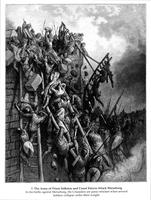
The Army of Priest Volkmar and Count Emocio attack Merseburg
Gustave Dore
Idylls of the King
Gustave Dore
Ancient Battle
Salvator Rosa
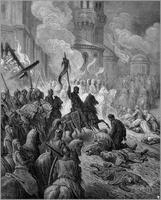
Entry of the Crusaders in Constantinople in 1204
Gustave Dore
Godfrey Meets the Remains of the Army of Peter the Hermit
Gustave Dore
Johannes, Merchent of Cordoba, Being Taken for Execution, AD 850
Jan Luyken
Scène de pillage
Theodor van Thulen
The Battle of Antioch
Gustave Dore
An Officer on horseback and four foot Soldiers
Antonio González Velázquez