
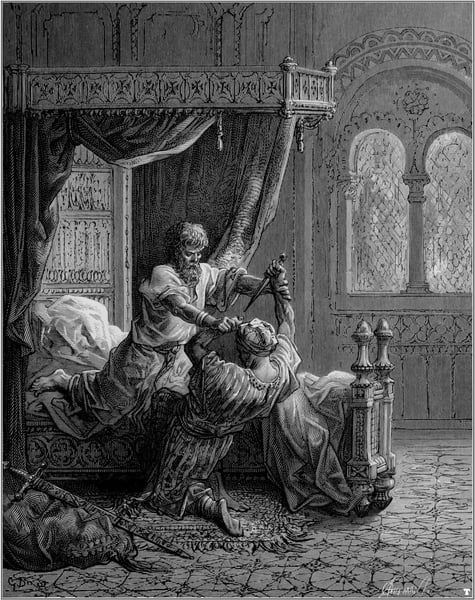
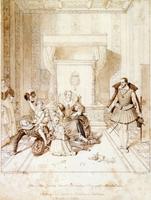
Edward I of England kills his would be assassin in June 1272
Details
Expert analysis of Gustave Dore’s Edward I of England kills his would be assassin in June 1272
Style: Romanticism · Genre: illustration
Expert Analysis: "Edward I of England kills his would be assassin in June 1272" by Gustave Doré
As an art historian examining this work through the lens of its supplied facts—style: Romanticism, genre: illustration—the significance of Gustave Doré's piece lies in its powerful synthesis of historical drama and Romantic visual language within the specific context of book or print illustration.
Stylistic Significance (Romanticism): Doré’s rendering is quintessentially Romantic in its emphasis on emotional intensity, heroic action, and the sublime chaos of violence. The scene captures a decisive, life-or-death moment—the king slaying his would-be assassin—which aligns with the Romantic fascination with individual heroism and the raw, untamed forces of history. The composition likely employs dramatic chiaroscuro and a dynamic, diagonal thrust of bodies to heighten tension, drawing the viewer into the visceral struggle. This is not a calm historical record but a theatrical, morally charged confrontation that evokes both the nobility of the monarch and the brutal reality of survival.
Genre Significance (Illustration): As an illustration, the work serves a dual purpose: it must faithfully narrate a specific historical event (Edward I surviving an assassination attempt in 1272) while also embodying the Romantic era’s desire to make the past feel immediate and emotionally accessible. Doré’s mastery lies in using the constraints of the printed page to amplify drama—every line, shadow, and gesture is compressed into a frozen instant that tells a story. This piece exemplifies how 19th-century illustrated books and periodicals elevated commercial art to high art, blending documentary precision with poetic exaggeration. Doré’s illustrations for works like The Divine Comedy and Paradise Lost set a standard; here, he applies that same gravitas to a lesser-known historical episode, treating it with the epic weight of a battle scene.
What Makes It Significant:
- Synthesis of History and Imagination: Doré transforms a factual event into a Romantic emblem of courage and rightful authority, reinforcing the period’s ideal of the monarch as both warrior and martyr-survivor.
- Illustration as High Drama: The work demonstrates that illustration need not be secondary or decorative; it can be a primary vehicle for Romantic expression, with each stroke contributing to a unified emotional impact.
- Visual Storytelling Mastery: Doré captures the precise moment of counterattack—likely showing Edward’s sword or fist striking the assassin—freezing the climax to maximize narrative tension. This decision makes the artwork memorable and instantly legible, a hallmark of great illustration.
In summary, while this piece may be lesser-known than Doré’s epic biblical or literary scenes, it is a potent example of Romantic historicism in illustration, where the artist’s dramatic flair transforms a chronicled event into a timeless emblem of human struggle and royal resilience.
Museum / Gallery
Visually similar
20 works with related composition and palette
Fulk-Nerra Assailed by the Phantoms of His Victims
Gustave Dore
Robbery
Fyodor Bronnikov
Honoric, King of the Vandals, Eaten by Worms and Lice, AD 477
Jan Luyken
Don Quixote
Gustave Dore
King David at prayer
Rembrandt
Death of the Virgin
Rembrandt
The Adventure of the Chamber Pot, plate four from Scènes du Roman Comique
Jean-Baptiste Oudry
Sanuti Showing Maps of the East to Pope John XXII
Gustave Dore
King László V and Ulrik Cillei
Bertalan Szekely
La muerte de Galeswinthe
Jean-Paul Laurens
Paolo Da Malatesta and Francesca Da Rimini Surprised by Gianciotto Malatesta
Joseph Anton Koch
Reclining Upon A Bed Was A Princess Of Radiant Beauty
Gustave Dore
Orlando Furioso
Gustave Dore
Don Quixote
Gustave Dore
In Bed
Rembrandt
Astonishment of the Crusaders at the Wealth of the East
Gustave Dore
Birth of Mary
Albrecht Durer
Raising of Jairus Daughter
Ilya Repin
The Life of St. Ignatius Loyola. Plate 1. Ignatius recovers from his wounds at Loyola.
Carlos Saenz de Tejada
Henry IV Playing with His Children
Jean Auguste Dominique Ingres