
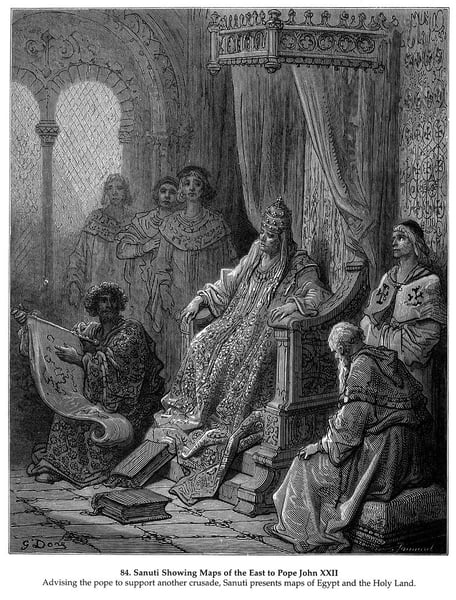
Analisi esperta di Sanuti Showing Maps of the East to Pope John XXII di Gustave Dore
Stile: Romanticism · Genere: illustration
Expert Art Historical Analysis: "Sanuti Showing Maps of the East to Pope John XXII" by Gustave Doré
Gustave Doré’s Sanuti Showing Maps of the East to Pope John XXII (c. 1870) stands as a prime exemplar of Romantic-era illustration, a genre in which Doré was an undisputed master. The work captures a pivotal moment of medieval diplomacy and geographical discovery, imbuing it with the dramatic chiaroscuro, emotional intensity, and narrative grandeur that define Romanticism.
Significance within Romanticism and Illustration
Doré’s illustration transcends mere historical record by transforming a scholarly consultation into a theatrical, almost sacred encounter. The composition is dominated by stark contrasts of light and shadow—a hallmark of Romantic visual language—that draw the viewer’s eye to the pope’s austere figure and the radiant, unfolded maps. The maps themselves glow with an almost supernatural luminescence, symbolizing the allure and mystery of the Orient, a common Romantic trope of exoticism and the unknown.
The scene’s significance lies in its fusion of the heroic-idealistic and the documentary. The pope, enthroned and draped in heavy robes, represents institutional authority, yet his gaze is fixed not on the viewer but on the cartographic evidence, suggesting a moment of intellectual exchange. Sanuti, leaning forward with a scroll, embodies the Romantic figure of the explorer-scholar—driven by curiosity and the desire to map the world. Doré’s meticulous rendering of architectural details, textures of fabric, and the aged faces of the figures anchors the fantastic subject in tangible, historical reality, a technique that elevates illustration to high art.
Doré’s work here is particularly significant as it exemplifies how Romantic illustration could rival history painting in gravitas and emotional power. It is not merely a decorative accompaniment but a self-contained narrative that speaks to themes of power, knowledge, and the expansion of geographical horizons—themes that resonated deeply in the 19th-century European imagination. The dynamic tension between the static papal figure and the animated messenger, combined with the almost palpable sense of light falling across parchment and stone, makes this a quintessential Doré: an image where history, fantasy, and technical virtuosity converge.
Visivamente simili
20 opere con composizione e palette affini
First Ecumenical Council of Nicaea
Vasily Surikov
The choice of a bride by Alexis of Russia
Konstantin Makovsky
Servant Presenting Saul S Crown to David
Carel Fabritius
Columbus Before the Queen
Emanuel Leutze
Fourth Ecumenical Council of Chalcedon
Vasily Surikov
Christ before Pilate
Rembrandt
Honoric, King of the Vandals, Eaten by Worms and Lice, AD 477
Jan Luyken
The King and the Beggar Maid
Edmund Blair Leighton

The King and the Beggar-maid
Edmund Blair Leighton
Pope Formosus and Stephen VI - The Cadaver Synod
Jean-Paul Laurens
Paolo and Francesca
Gustave Dore
Prince Alexander Nevsky Receiving Papal Legates
Henryk Siemiradzki
Passion of Christ
Christoph Schwarz
Edward I of England kills his would be assassin in June 1272
Gustave Dore
St. Francis of Assisi
Gustave Dore
King László V and Ulrik Cillei
Bertalan Szekely
The Life of St. Ignatius Loyola. Plate 7. Pope Paul III approves the Society of Jesus 27th September 1540 Regimini Militantes.
Carlos Saenz de Tejada

Doge Francesco Foscari’s Removal (The Two Foscari)
Francesco Hayez
Vows John Kaz
Jan Matejko
Queen Vashti Refuses to Obey Ahasuerus' Command
Gustave Dore