
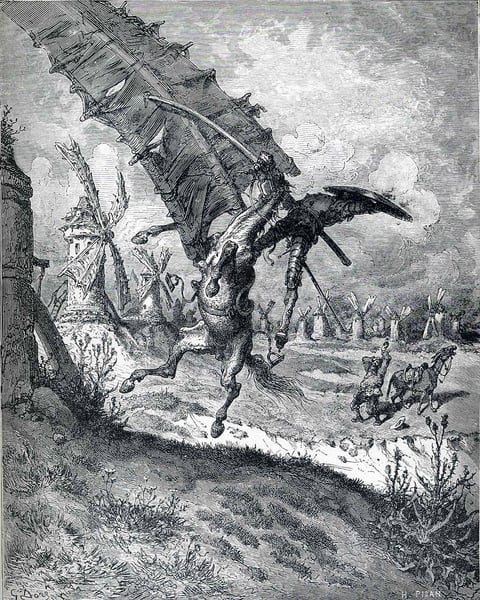
Analisi esperta di The Adventure with the Windmills di Gustave Dore
Stile: Romanticism · Genere: illustration
Expert Analysis: "The Adventure with the Windmills" by Gustave Doré
Artwork: The Adventure with the Windmills (illustration for Don Quixote)
Artist: Gustave Doré
Style: Romanticism
Genre: Illustration
Significance within Romanticism and Illustration
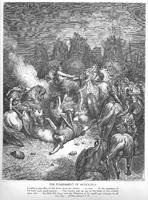
Gustave Doré’s The Adventure with the Windmills is a masterclass in Romantic illustration, where the artist transforms a literary moment into a visual epic. The work belongs to his celebrated series of engravings for Miguel de Cervantes’ Don Quixote (published in the 1860s), and it captures the quintessentially Romantic theme of the heroic ideal clashing with mundane reality—here, the tilting at windmills that Quixote mistakes for giants.
1. Dramatic Sublime in a Small Frame
Romanticism prized intense emotion, the sublime, and the power of nature. Doré imbues the scene with a theatrical grandeur: the windmills are rendered as colossal, almost monstrous forms against a brooding sky, their sails like outstretched arms. The scale dwarfs Quixote, emphasizing both his folly and his tragic nobility. The chiaroscuro—deep shadows contrasted with stark light—heightens the tension, a hallmark of Romantic printmaking that Doré elevated to an almost cinematic intensity.
2. Elevating Illustration to High Art
Before Doré, illustration was often viewed as a secondary craft. He broke that boundary by treating the page as a canvas for monumental composition. Every line in The Adventure with the Windmills serves narrative and emotional purpose: the diagonal thrust of the charging horse, the chaotic energy of the windmill blades, and the isolated figure of Quixote, who seems both absurd and heroic. This fusion of literary detail with painterly drama made Doré’s illustrations definitive for generations—his Quixote is arguably as famous as the novel itself.
3. The Romantic Hero: Madness as Vision
Central to Romanticism is the figure of the artist/hero who sees beyond the ordinary. Doré captures Quixote at the moment of delusion, yet the engraving does not mock him. Instead, it invites the viewer to feel the exhilaration of his impossible quest. The windmills are not just machines; they become symbols of the sublime—vast, indifferent, and charged with the power of imagination. This duality—the tension between the ridiculous and the sublime—is the very heart of Romantic irony.
4. Technical Mastery
Doré’s engraving technique is essential to the work’s impact. His use of cross-hatching and varied line weight creates texture and atmosphere: the gritty earth, the swirling sky, the metallic gleam of armor. The composition is dynamic, with the viewer placed low and close, as if caught in the dust of the charge. This immersive quality was revolutionary for book illustration, making the image not merely decorative but an integral part of the reading experience.
Conclusion:
The Adventure with the Windmills exemplifies Romanticism’s celebration of the visionary, the dramatic, and the emotionally charged. Doré’s illustration transcends its genre, standing as a powerful meditation on the human need to transform the ordinary into the extraordinary. It is a cornerstone of 19th-century visual culture, proving that the illustrator’s art could achieve the same expressive height as history painting or landscape.
Museum / Gallery
Visivamente simili
20 opere con composizione e palette affini
A009 - Don Quixote fights against the windmills
Ramiro Martín Martín
Don Quixote
Gustave Dore
Don Quixote
Gustave Dore
Don Quixote
Gustave Dore
The Inferno, Canto 22
Gustave Dore
Don Quixote
Gustave Dore
Alichino & Calcabrina
Gustave Dore
Devils and Virgil
Gustave Dore
The Inferno, Canto 21
Gustave Dore
Devils and Barrators
Gustave Dore
There it goes
Francisco Goya
Geryon--Symbol of Deceit
Gustave Dore
The Descent on The Monster
Gustave Dore
The Inferno, Canto 21
Gustave Dore
Pegasus
Georgi Mashev
Barrators--Giampolo
Gustave Dore
Satan's Flight Through Chaos
Gustave Dore
Don Quixote
Gustave Dore
Don Quixote
Gustave Dore
The Punishment of Antiochus
Gustave Dore