
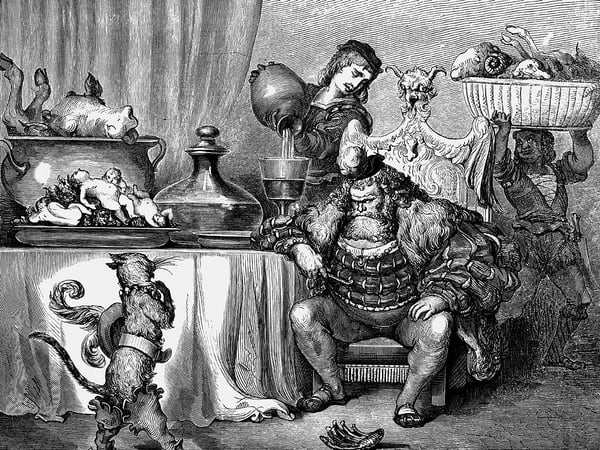
The Ogre Received Him As Civilly As An Ogre Can
Ayrıntılar
Gustave Dore sanatçısının The Ogre Received Him As Civilly As An Ogre Can eseri hakkında uzman analizi
Tarz: Romanticism · Tür: illustration
Expert Analysis: "The Ogre Received Him As Civilly As An Ogre Can" by Gustave Doré
This work, an illustration by Gustave Doré, stands as a quintessential example of Romanticism in the realm of book illustration. The very title—drawn from a literary source (likely Charles Perrault’s fairy tale “Little Thumb” or a similar story)—announces the Romantic fascination with folklore, the fantastic, and the tension between the sublime and the grotesque.
Significance within Romanticism: Doré’s illustration captures the Romantic era’s obsession with intense emotion, the supernatural, and the dramatic power of light and shadow. The phrase “as civilly as an ogre can” implies a darkly ironic juxtaposition of courtly decorum with monstrous nature—a classic Romantic motif that pits civilized forms against raw, primal forces. In this single scene, Doré condenses a narrative of peril, psychological unease, and the sublime terror of the unknown.
Stylistic Importance: As a master of wood engraving, Doré elevated the genre of illustration to a high art form. His technique—marked by intricate cross-hatching, deep chiaroscuro, and a theatrical sense of scale—imbues even a static scene with kinetic energy. The composition would likely place the human protagonist in a vulnerable position before the towering, shadowy ogre, whose exaggerated features and cavernous surroundings evoke the Romantic sublime: awe mixed with dread. This approach was revolutionary for the mid-19th century, proving that illustrations could carry the same emotional weight as easel paintings.
Genre and Cultural Impact: Within the illustration genre, this work exemplifies Doré’s unparalleled ability to visually interpret literature. His illustrations became the definitive visual language for countless classic texts—Dante, Milton, Cervantes, and the fairy tales of Perrault. By making the monstrous “civil,” Doré subverts expectations and deepens the narrative complexity, inviting viewers to question the boundaries of civility and savagery. This interplay of the familiar and the fantastic is a hallmark of Romanticism’s interest in the irrational and the hidden recesses of the human psyche.
In sum, “The Ogre Received Him As Civilly As An Ogre Can” is significant for its masterful synthesis of Romantic themes—emotional intensity, the grotesque sublime, and literary imagination—all executed through Doré’s technical virtuosity in illustration, a genre he helped transform into a vehicle for profound artistic expression.
Görsel olarak benzer
İlişkili kompozisyon ve renk paletine sahip 20 eser
Banquet on a Terrace
Esaias van de Velde
Don Quixote
Gustave Dore
Don Quixote
Gustave Dore
"One of the Men Who Remained at the Table Laughed, and the Other Began Singing a Low Song"
Richard Caton Woodville Jr.
Honoric, King of the Vandals, Eaten by Worms and Lice, AD 477
Jan Luyken
A Midnight Modern Conversation
William Hogarth
Pilate Washing his Hands
Albrecht Durer
Don Quixote
Gustave Dore
Don Quixote
Gustave Dore
Don Quixote
Gustave Dore
Salome With The Head Of John The Baptist
Lucas van Leyden
Columbus Breaking the Egg (Christopher Columbus)
William Hogarth
Burning of William White, a Priest, Norwich, England, AD 1428
Jan Luyken
Don Quixote
Gustave Dore
Christ before Herod
Albrecht Durer
The Mocking of Christ
Albrecht Durer
Jacques de Caumont
Frederick Sandys
Christ at Emmaus
Rembrandt
Count William III of Holland Permitting the Beheading of His Bailiff
Willem van Swanenburg
The idolatry of Solomon
Lucas van Leyden