Marc Chagall の The Drunkard の専門的な分析
スタイル:Cubism · ジャンル:genre painting
Expert Analysis: "The Drunkard" by Marc Chagall
Marking a pivotal moment in early 20th-century modernism, Marc Chagall’s “The Drunkard” stands as a singular fusion of Cubist structure with the artist’s signature poetic and folkloric sensibility. While Cubism—pioneered by Picasso and Braque—typically pursued analytical decomposition of form and a muted, monochromatic palette, Chagall injects the style with vivid color, emotional narrative, and a distinctly personal iconography.
Significance Within Cubism and the Period:
-
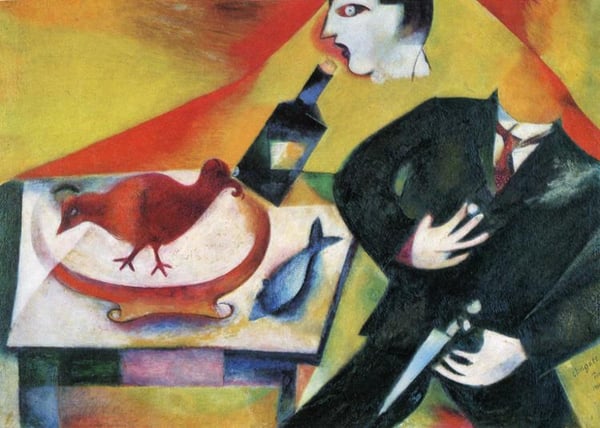
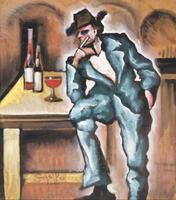
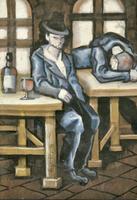
Hybridizing Cubism with Expressionist Emotion: Chagall adopts Cubism’s shattered planes and spatial dislocations (e.g., tilted tabletops, fragmented facial features) but applies them to a genre scene charged with psychological weight. The drunkard is not merely a formal exercise; his lurching posture and blurred surroundings evoke intoxication, instability, and a melancholy rootlessness—themes alien to the detached intellectualism of orthodox Cubism.
-
Color as Emotional Catalyst: Unlike the monochrome of early Cubism, Chagall saturates the canvas with bold, unnatural hues—deep burgundies, murky greens, and floating patches of white. This liberates the scene from pure representation, allowing color to signify mood rather than volume. The drunken figure nearly merges with the table and background, suggesting the loss of self and the breaking of rational boundaries.
-
Genre Painting Transformed: Traditional genre scenes (depictions of everyday life) often aimed for anecdotal or moralizing clarity. Chagall subverts this by making the everyday strange. The drunkard’s floating, almost levitating head, the inverted glass, and the disjointed still life elements turn a tavern vignette into a dreamlike or nightmarish vision—blending reality with the subconscious, a hallmark of Chagall’s later Surrealist influence.
Why It Matters: “The Drunkard” exemplifies how Cubism could serve narrative and emotional expression beyond formal innovation. Chagall’s adaptation demonstrates that Cubism was not a rigid doctrine but a flexible language; he used its fractured geometry to capture the disorienting experience of intoxication—both literal and spiritual. In doing so, he bridges the gap between avant-garde experimentation and the enduring human stories that animated Symbolism and Expressionism. This work is a testament to Chagall’s role as a synthesizer who expanded Cubism’s reach into the realms of memory, folklore, and raw feeling.
Museum / Gallery
視覚的に類似
構図やパレットが近い作品 20 件
The Poet, or Half Past Three
Marc Chagall
The Architect, Jesus T. Acevedo
Diego Rivera
The Man with the Bottle
Gustave de Smet
Dinner in Honor of Meeting
Nina Tokhtaman Valetova
Portrait of Ramon Gomez de la Serna
Diego Rivera
Armut
Lasar Segall
Woman in a Café: Compenetrations of Lights and Planes
Umberto Boccioni
Smoker
Lyubov Popova
Aldeia Russa
Lasar Segall
Family Excursions
Max Ernst
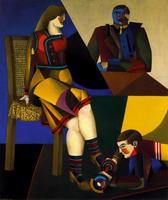
The table
Richard Lindner
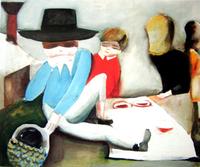
The Picnic
Charles Blackman
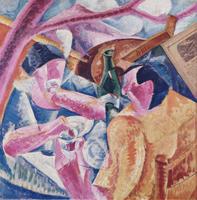
Under the Pergola at Naples
Umberto Boccioni
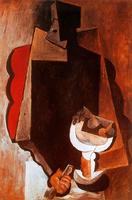
Figure with fruit dish
Pablo Picasso
Young Couple
Heinrich Campendonk
A three-handed game
Danil Nemirovsky
Sailor at Breakfast
Diego Rivera
Still Life with Bottle and Glass
Juan Gris
Scheiber Hugó, Korhely
Scheiber Hugó
Scheiber Hugó, Ivóban
Scheiber Hugó