Analisi esperta di Scene at the Entrance of a Cathedral di Karl Bryullov
Stile: Neoclassicism · Genere: genre painting
Expert Analysis: "Scene at the Entrance of a Cathedral" by Karl Bryullov
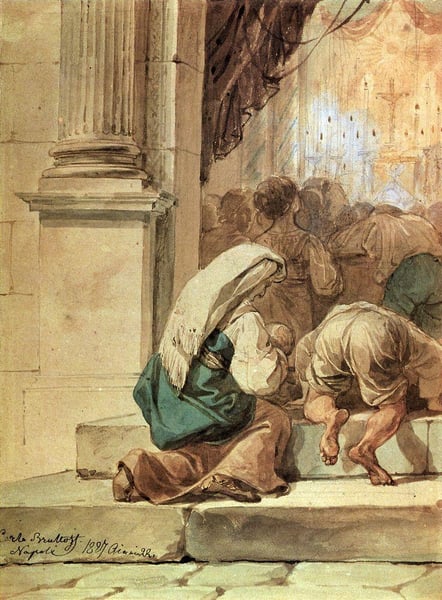
Karl Bryullov (1799–1852) is best known for his monumental history painting The Last Day of Pompeii, which bridges Neoclassicism and Romanticism. However, his genre scenes—such as Scene at the Entrance of a Cathedral—reveal his mastery of capturing everyday life through a Neoclassical lens. This work is significant for how it transforms a mundane urban moment into a composition of classical harmony, dignity, and human warmth.
Composition and Style:
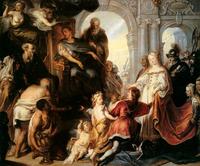
True to Neoclassicism, Bryullov structures the scene with balanced, frieze-like groupings. The cathedral entrance acts as an architectural backdrop, its columns and arches echoing the severity and order of classical antiquity. Figures are arranged in clearly defined planes, with a careful interplay of light and shadow that models forms like antique statuary. The artist uses a restrained palette—golds, ochres, and muted grays—to evoke a timeless, serene atmosphere.
Narrative and Detail:
Despite the genre designation, the painting is not merely documentary. Bryullov infuses the scene with subtle psychological interaction: a beggar woman at the steps, a noble family alighting from a carriage, a priest in conversation with a parishioner. Each figure is individualized, yet they coexist in a narrative of social strata meeting at a sacred threshold. The cathedral doors—half-open, framing a dim interior—symbolize the transition from worldly bustle to spiritual refuge.
Significance within Neoclassicism and Bryullov’s Oeuvre:
While Bryullov’s contemporaries often reserved Neoclassical formal rigor for history painting or mythology, he applied it to genre—elevating the ordinary to the ideal. This work demonstrates that Neoclassicism was not limited to heroic subjects; it could also imbue daily life with order, clarity, and moral gravity. Bryullov’s careful treatment of costume, architecture, and gesture aligns with the Neoclassical belief in art as a civilizing force, revealing the harmony that underlies even chaotic urban existence.
In Scene at the Entrance of a Cathedral, Bryullov proves that the grand principles of Neoclassicism—balance, restraint, and idealized form—are as potent in a snapshot of street life as in a mythological epic. It stands as a testament to his versatility and his ability to find classical beauty in the transient, the humble, and the human.
Visivamente simili
20 opere con composizione e palette affini
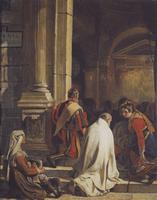
Vespers
Karl Bryullov
Tobias and his blind father
Orest Kiprensky
Raising of the Daughter of Jairus
Paolo Veronese
Charity of Saint Elladius of Toledo
Francisco Bayeu y Subias
The Mocking of Christ. From the biblical sketches.
Alexander Ivanov
Adoration of the Magi
Nicolas Poussin
Christ Among the Doctors
Luca Giordano
Presentation of the Virgin in the Temple
Eustache Le Sueur
Presentation of Christ in the Temple
Simon Vouet
Presentation in the Temple
Giovanni Domenico Tiepolo
Galatea
Giovanni Battista Piranesi
A Scene from Roman History
Sebastien Bourdon
Death of Dido
Giovanni Battista Tiepolo
Jesus Blessing the Children
Gustave Dore
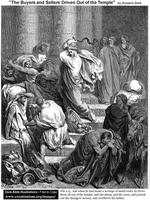
The Buyers And Sellers Driven Out Of Temple
Gustave Dore
The death of Virginia
Vincenzo Camuccini

Psyche's Parents Offering Sacrifice to Apollo
Luca Giordano
Alexander the Great in the Temple of Jerusalem
Sebastiano Conca
Sacrificio Di Polissena
Giambattista Pittoni
Scipio Africanus
Theodoor van Thulden