Analisi esperta di Emblemata - Well di M.C. Escher
Stile: Expressionism · Genere: illustration
Expert Analysis: "Emblemata - Well" by M.C. Escher (c. 1931)
Style & Period Context:
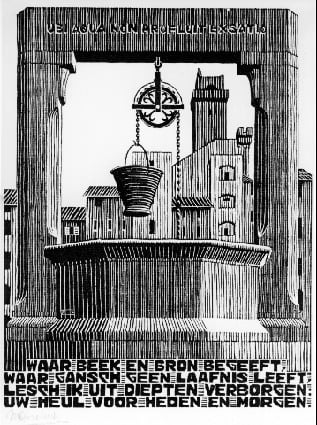
While M.C. Escher is globally recognized for his later mathematically hypnotic tessellations and impossible constructions, "Emblemata - Well" belongs to his earlier, less celebrated phase. Here, the artist works firmly within Expressionism, a movement that prioritizes emotional intensity, subjective interpretation, and distorted reality over naturalistic representation. As an illustration, this piece serves a narrative or symbolic purpose, drawing on the centuries-old tradition of emblem books—a Renaissance genre where allegorical images are paired with moralizing texts. Escher’s Emblemata series (1931) directly revives this format, but filtered through a distinctly modern, German Expressionist lens.
What Makes It Significant:
-
Fusion of Historical and Avant-Garde: Escher marries the didactic, emblematic structure of the 16th–17th centuries (e.g., Alciato’s Emblemata) with the raw, angular woodcut technique favored by Expressionists like Ernst Ludwig Kirchner. The “Well” is not merely a source of water but a symbolic locus—likely referencing the proverb “Truth lies at the bottom of a well,” or the human effort to draw knowledge from depth. The expressionistic treatment (exaggerated shadows, jagged lines, stark black-and-white contrast) transforms a static allegory into a scene of tense physical exertion.
-
Proto-Surrealist Imagination: Although classified as Expressionism, this work hints at Escher’s future fascination with ambiguous spaces and paradoxical perspectives. The well’s architecture seems to warp; the bucket, rope, and masonry are rendered with a hyper-specific, almost hallucinatory clarity that destabilizes the viewer’s sense of scale and gravity. This early synthesis of the symbolic and the unreal prefigures his mature optical illusions.
-
Technical Mastery of Woodcut: Escher was a virtuoso printmaker, and “Emblemata - Well” showcases his command of the medium. The sharp, deliberate cross-hatching and the play of negative space create a pulsating surface rhythm—the well’s opening feels like a vortex drawing the eye inward. This textural intensity amplifies the motif’s metaphysical weight, making the ordinary act of drawing water feel archetypal and unsettling.
-
Bridge Between Art and Literature: As an illustration for an emblem book, the piece fulfills a specific narrative function (to be paired with a moral epigram), yet it transcends mere decoration. The well becomes a threshold between the known and the hidden, the conscious and the subterranean—a theme Escher would later explore explicitly in works like Ascending and Descending or Waterfall.
Conclusion:
“Emblemata - Well” is significant as a pivot point in Escher’s career—a work steeped in historical allegory but executed with the expressive, distorted energy of early 20th-century printmaking. It demonstrates that even before his iconic mind-bending geometries, Escher was an artist deeply engaged with symbolism, craftsmanship, and the psychological power of everyday objects rendered strange.
Visivamente simili
20 opere con composizione e palette affini
The Treasure of Carcassonne
Dorothy Lathrop
Young shepherd at the well
Filippo Indoni
Village well
Mubarak Atmata
Spirit of the Well
Alexandre Charles Guillemot
Women at the Well
Paul Signac
Well in summer
Constant Troyon
Exlibris of B.Solman
Oleksandr Aksinin
Exlibris P. N.
Oleksandr Aksinin
Young Woman and Child at the Well
Camille Pissarro
Landscape with fountain
Paul Cezanne
Na Cisterna
António de Carvalho da Silva Porto
Exlibris T.B. S.
Oleksandr Aksinin
The water wheel [sketch]
Silvestro Lega
A well between two properties
Francois-Marie Firmin-Girard
By the Well
Guillaume Seignac
The Treasure of Carcassonne
Dorothy Lathrop
Exlibris of Oleksiy Itutin
Oleksandr Aksinin
The Well
Le Nain brothers
Near the well
Achille De Dominics
At the Well
Henry Herbert La Thangue