
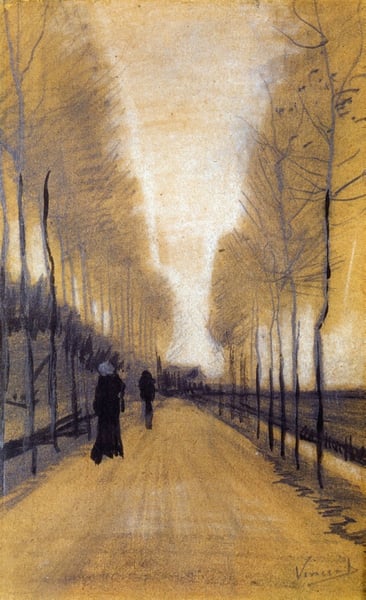
Alley Bordered by Trees
Details
Expert analysis of Vincent van Gogh’s Alley Bordered by Trees
Style: Realism · Genre: landscape
Expert Analysis of "Alley Bordered by Trees" by Vincent van Gogh
This work, executed during van Gogh's early period in Nuenen (circa 1884–85), is a compelling example of his commitment to the Realism style at a time when many of his contemporaries were moving toward Impressionism. While van Gogh is best known for his later Post-Impressionist works, this painting demonstrates his foundational mastery of direct observation and his ability to render the natural world with precise fidelity.
Significance within Realism
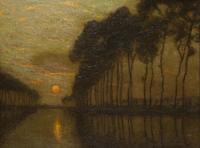
The painting adheres to the core tenets of Realism: an unembellished, honest depiction of everyday rural life and landscape. Van Gogh focuses on a humble, unremarkable subject—a lane bordered by pollard willows—and elevates it through meticulous attention to light, texture, and spatial depth. The gnarled trunks and bare branches are rendered with a careful, almost studied naturalism, avoiding the dramatic color or expressive brushwork of his later years. Instead, he employs a subdued earthy palette of browns, grays, and muted greens, capturing the quiet stillness of the Dutch countryside.
Technical and Thematic Highlights
- Atmospheric Perspective: Van Gogh carefully grades the tones to create a convincing recession into the distance. The path narrows and the trees diminish in scale, guiding the viewer’s eye toward the hazy horizon—a hallmark of academic Realist landscape painting.
- Light and Shadow: The dappled light filtering through the bare branches is observed with scientific precision. The interplay of warm sunlight on the path and cool shadows under the trees shows van Gogh’s sensitivity to natural illumination, a skill he would later transform into his signature vibrant contrasts.
- Rural Authenticity: The pollarded willows—a common sight in the agricultural lowlands—are not romanticized. Their twisted forms suggest human intervention and the rhythms of peasant life, aligning with the Realist interest in depicting unidealized, working landscapes.
Place in van Gogh’s Evolution
This painting is crucial for understanding van Gogh’s artistic development. It represents his disciplined study of nature before he embraced the symbolic color and emotional intensity of his later works. While not as famous as Starry Night or Sunflowers, Alley Bordered by Trees shows a young artist rigorously training his eye and hand within the Realist tradition. The careful structure and quiet dignity of this landscape foreshadow the sensory power he would later unleash, making it a foundational piece that grounds his entire oeuvre in a profound respect for observed reality.
Museum / Gallery
Visually similar
20 works with related composition and palette
Landscape with Woman Walking
Vincent van Gogh
La Route Nationale à Chessy
Léo Gausson
Avenue of Poplars at Sunset
Vincent van Gogh
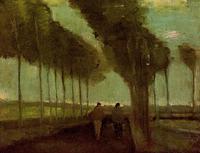
Country Lane with Two Figures
Vincent van Gogh
Forest Road near Oranjewoud
Jan Mankes
Country Lane with Trees
Vincent van Gogh
A Dutch Road
Anton Mauve
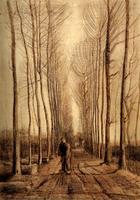
Avenue of Poplars
Vincent van Gogh
The Poplar Avenue, after Hobbema
David Cox
WINTER SUNSET
Boris Vasilievich Bessonov
Lane with Poplars
Vincent van Gogh
Canal in Flanders
Theo van Rysselberghe
Lane with Trees and One Figure
Vincent van Gogh
Avenue of trees in a small town
Alfred Sisley
Autumn Landscape
Vincent van Gogh
Moonlight at the Canal in Bruges
Charles Warren Eaton
Autumn Landscape at Dusk
Vincent van Gogh
Paysage Enneigé
Pierre-Jacques Pelletier
Poplar Trees
Vincent van Gogh
The Bruges Canal
Charles Warren Eaton