
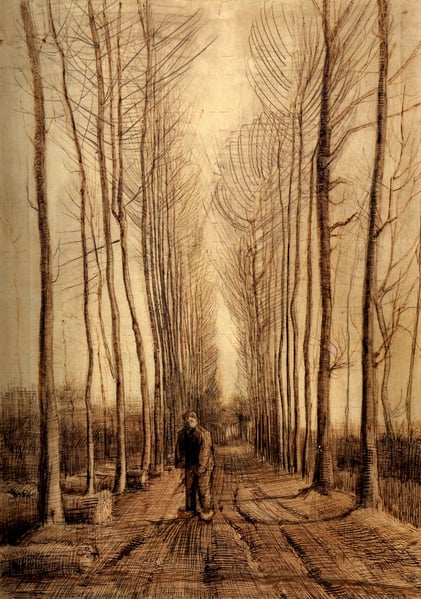
Expert analysis of Vincent van Gogh’s Avenue of Poplars
Style: Realism · Genre: landscape
Expert Analysis: "Avenue of Poplars" by Vincent van Gogh
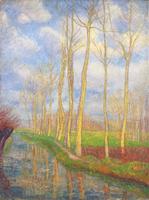
Despite Vincent van Gogh’s later fame as a Post-Impressionist, "Avenue of Poplars" reflects a foundational commitment to Realism—a style that prioritizes accurate, unidealized depiction of everyday scenes. This landscape painting captures a simple rural path lined with poplar trees, rendered with the observational precision and earthy palette characteristic of Realist practice.
Significance within Realism and Landscape Painting
- Faithful observation of nature: The work demonstrates van Gogh’s early dedication to rendering the natural world without embellishment. The carefully graded recession of the trees, the nuanced shadows on the road, and the subdued sky all adhere to Realism’s core principle of depicting life as it is.
- Emphasis on rural subject matter: Like many Realist painters (e.g., Courbet, Millet), van Gogh elevates a mundane, agricultural landscape—a lane of poplars—rather than an idealized or classical scene. This aligns with Realism’s focus on the everyday lives of common people and the environments they inhabit.
- Technical restraint and structure: The painting’s strong diagonal composition, balanced by the vertical poplars, showcases van Gogh’s grounding in Realist draftsmanship. The brushwork is controlled, the colors are naturalistic (browns, greens, muted blues), and the light is diffused—all hallmarks of the Realist approach.
What Makes It Significant for van Gogh’s Artistic Development
Even within the confines of Realism, "Avenue of Poplars" hints at van Gogh’s emerging sensitivity to texture and emotional resonance. The careful rendering of the tree trunks and the subtle play of light on the path foreshadows his later, more expressive use of color and brushwork. Yet here, he remains firmly within the Realist tradition, proving his ability to master the style’s demands before breaking from them.
In summary, "Avenue of Poplars" is significant as a mature Realist landscape that demonstrates van Gogh’s technical skill, his commitment to observational truth, and his engagement with the rural scenes that would later become a central theme in his revolutionary Post-Impressionist works.
Museum / Gallery
Visually similar
20 works with related composition and palette
Poplar Trees
Vincent van Gogh
Lane with Trees and One Figure
Vincent van Gogh
Alley Bordered by Trees
Vincent van Gogh
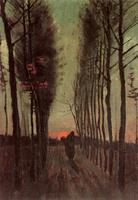
Avenue of Poplars at Sunset
Vincent van Gogh
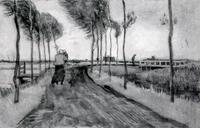
Landscape with Woman Walking
Vincent van Gogh
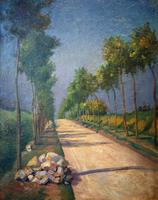
La Route Nationale à Chessy
Léo Gausson
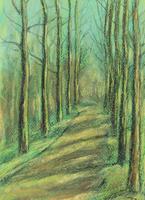
Spring in the Park
Alina Danilova
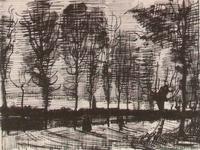
Lane with Poplars
Vincent van Gogh
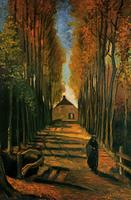
Avenue of Poplars at Sunset
Vincent van Gogh
Canal in Flanders
Theo van Rysselberghe
Landscape at Courrières
Jules Breton
The Poplar Avenue, after Hobbema
David Cox
The undergrowth in Quimper
Jules Breton
WINTER SUNSET
Boris Vasilievich Bessonov
The Flood
Claude Monet
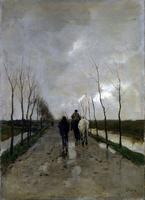
A Dutch Road
Anton Mauve
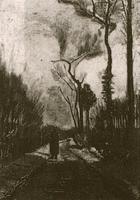
Lane in Autumn
Vincent van Gogh
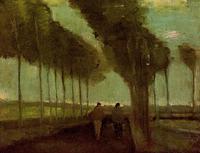
Country Lane with Two Figures
Vincent van Gogh
The high beam
Hanno Karlhuber
Poplars
Gustave Loiseau