
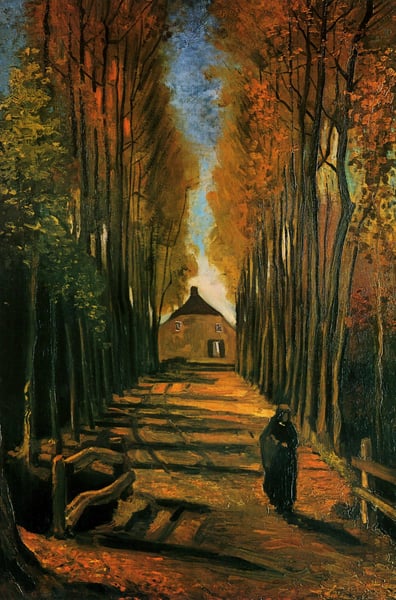
Avenue of Poplars at Sunset
Details
Expert analysis of Vincent van Gogh’s Avenue of Poplars at Sunset
Style: Realism · Genre: landscape
Expert Analysis: Avenue of Poplars at Sunset by Vincent van Gogh
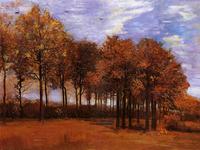
Executed in a Realist style, van Gogh’s Avenue of Poplars at Sunset stands as a masterful landscape that captures the transient beauty of twilight with striking fidelity. The work demonstrates the artist’s early commitment to observing nature directly, prefiguring his later expressive breakthroughs while remaining anchored in the rigorous observation of light, atmosphere, and spatial depth.
Significance within Realist Landscape Painting
Although van Gogh is most celebrated for his Post-Impressionist works, this painting exemplifies the core Realist ambition: to render the world as it is, with honesty and attention to fleeting optical effects. The receding line of poplars—their trunks growing thinner and more muted toward the vanishing point—showcases a sophisticated command of linear perspective and atmospheric perspective, hallmarks of the Realist devotion to spatial truth. The warm, low-angle sunset light casts long shadows across the path, and the sky transitions from a deep golden glow near the horizon to a cooler, violet-tinged zenith, faithfully recording the sunset’s gradations.
What makes this work particularly significant is van Gogh’s ability to infuse a seemingly simple rural subject with a palpable sense of temporal specificity. The realism here is not merely photographic; it is a record of a precise moment—the sun dipping below the horizon, the stillness of the trees, the quiet dustiness of the road. The artist’s brushwork, while more restrained than his later impasto, still reveals a tactile engagement with the canvas, subtly varying texture to differentiate foliage from sky from earth.
In the context of late 19th-century Realism, Avenue of Poplars at Sunset shows van Gogh synthesizing the Dutch landscape tradition (with its emphasis on horizontal lines and humble subject matter) with the French Realist focus on plein-air observation and tonal harmony. The painting’s significance thus lies in its demonstration that Realist principles—faithful representation, careful observation of light, and unadorned naturalism—can evoke the sublime beauty of the everyday, a quality that would later be transformed but never abandoned in van Gogh’s mature work.
Museum / Gallery
Visually similar
20 works with related composition and palette
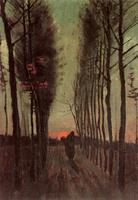
Avenue of Poplars at Sunset
Vincent van Gogh
Undergrowth
Felix Vallotton
The Flood
Claude Monet
Lane of Trees
Odilon Redon
In the Woods
Gustave Loiseau
Landscape at Courrières
Jules Breton
The Sin le Noble Road near Douai
Camille Corot
Country Lane with Two Figures
Vincent van Gogh
A Walk Through the Park
Nicolae Vermont
In the Woods
Camille Pissarro
Avenue of Poplars
Vincent van Gogh
Crecy-la-Chapelle, la route de Voulangis
Andre Dunoyer de Segonzac
Parkway
Isaac Levitan
La Route Nationale à Chessy
Léo Gausson
Landschap in de buurt van Vorden
Arnold Marc Gorter
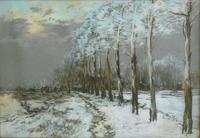
Paysage Enneigé
Pierre-Jacques Pelletier
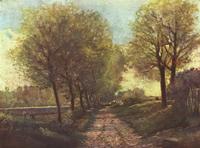
Avenue of trees in a small town
Alfred Sisley
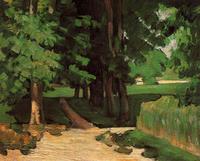
Lane of Chestnut Trees at the Jas de Bouffan
Paul Cezanne
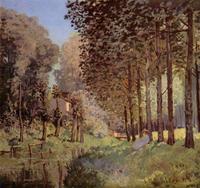
The rest beside d`un Creek
Alfred Sisley
Autumn Landscape
Vincent van Gogh