Analysis of "Vincent's Bedroom in Arles"
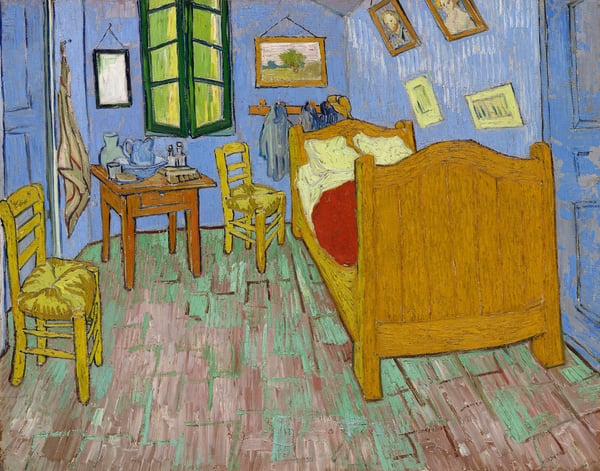
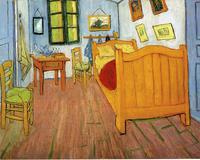
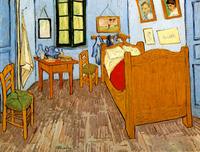
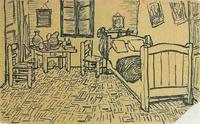
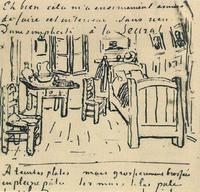
As a Post-Impressionist interior, this work exemplifies the movement's departure from naturalistic representation in favor of subjective emotional truth. Van Gogh reduces the bedroom to a composition of starkly angled lines and simplified forms—a deliberate distortion that conveys the artist's inner state rather than optical accuracy. The choice of an intimate, unassuming subject (the artist’s own bedroom) is significant within Post-Impressionism, which often elevated mundane scenes to vehicles for intense personal expression.
The genre of interior allows van Gogh to create a closed, contemplative space. The tilted perspective and tightly compressed spatial arrangement (with the bed, chairs, and wall paintings pressing forward) evoke a sense of psychological confinement and restlessness, contrasting with the expected serenity of a bedroom. This tension—between the ordinary subject and its charged, almost jarring presentation—marks a key contribution of Post-Impressionism: the transformation of a private, domestic setting into a bold statement of individual vision, where color, line, and composition override mere description.