
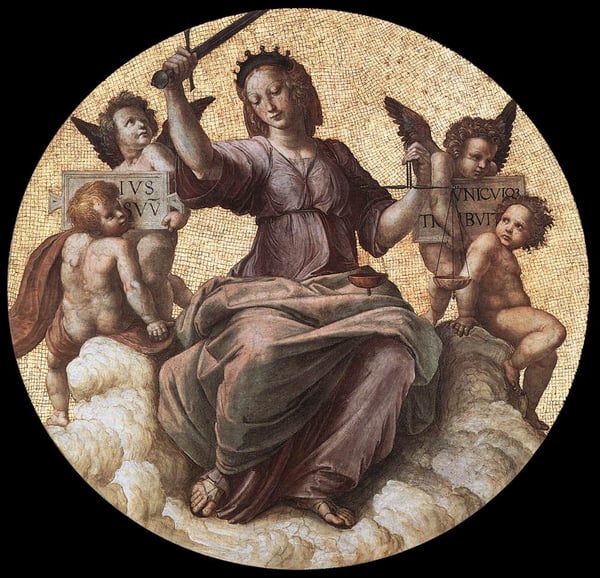
Analisi esperta di Justice, from the 'Stanza della Segnatura' di Raphael
Stile: High Renaissance · Genere: allegorical painting
Expert Analysis: "Justice" (from the Stanza della Segnatura) by Raphael
As one of the four cardinal allegories adorning the private library of Pope Julius II, Raphael’s fresco Justice (c. 1508–1511) is a quintessential expression of the High Renaissance synthesis of classical virtue, Christian theology, and humanist learning. Painted within the Stanza della Segnatura—the room that housed the Pope’s personal library and served as the seat of the Church’s highest tribunal—this figure embodies the ideal of balanced authority, both divine and temporal.
Composition and Symbolism
The fresco belongs to a unified ceiling program where each cardinal virtue corresponds to a major discipline on the walls below: Justice presides over the Jurisprudence section (the opposite wall features civil and canon law scenes). Raphael portrays Justice as a majestic seated female figure, holding her traditional attributes: the scales (signifying measured judgment) and the sword (representing punitive authority). She is flanked by four putti who symbolize the “sub-virtues” of Justice: Prudence, Fortitude, Temperance, and (again) Justice. Within the room’s programmatic logic, the allegory directly responds to the adjacent Disputation of the Holy Sacrament (theology) and School of Athens (philosophy), reinforcing the Renaissance conviction that justice is the essential framework for both spiritual and rational life.
Artistic Significance
-
Harmony of Form and Meaning – Raphael achieves a perfect balance typical of the High Renaissance: the figure’s contrapposto is graceful yet authoritative, her drapery falling in deep, orderly folds that echo the geometric stability of the tondo frame. The clear, symmetrical composition mirrors the concept of justice as a harmonizing force.
-
Integration of Antique and Christian Ideals – The allegory draws directly from Roman depictions of Iustitia (often shown with scales) but reimagines her as a Christian virtue. This fusion of classical form with Christian allegory exemplifies the humanist project of the Stanza della Segnatura.
-
Programmatic Role – The fresco is not an isolated decoration; it is a conceptual keystone. The Stanza della Segnatura was where papal legal decisions were approved. By placing Justice above the room’s signature function, Raphael elevates law as a divine and rational ideal, connecting the Pope’s earthly judgments to heavenly order.
-
Raphael’s Mastery of Fresco – The delicate modeling of flesh, the subtle gradations of color, and the seamless integration of the figure into the complex vaulted ceiling demonstrate Raphael’s technical brilliance. The foreshortening and perspective are calibrated so that the allegory appears weightless yet grounded—an illusionistic tour de force.
Why It Matters
Justice is significant as part of the foundational cycle that established Raphael as the supreme painter of the High Renaissance. It encapsulates the era’s core belief that art could embody moral philosophy, rendering abstract virtues with vivid, human grace. The fresco’s serene authority prefigures the mature Raphael’s influence on subsequent generations, from Michelangelo’s Sistine Chapel to the idealized allegories of the Baroque. Most crucially, it demonstrates how the Stanza della Segnatura functions as a complete intellectual microcosm—a visual summa of Renaissance thought—where Justice stands not merely as a virtue but as the necessary bond between heaven, reason, and earthly governance.
Museum / Gallery
Visivamente simili
20 opere con composizione e palette affini
Theology, from the 'Stanza della Segnatura'
Raphael
Poetry, from the 'Stanza della Segnatura'
Raphael
Philosophy, from the 'Stanza della Segnatura'
Raphael
The Assumption of the Virgin
Philippe de Champaigne
Allegory of Happiness
Tintoretto
TWO GILDED PANELS BELIEVED TO COME FROM ONE OF THE ROYAL COACHES OF GEORGE I, WITH CLASSICAL PERSONIFICATIONS OF ENGLAND AND SCOTLAND BEARING ARMORIAL SHIELDS MONOGRAMED WITH THE KING'S INITIALS
James Thornhill
Gloria Di Santa Marta
Giovanni Battista Gaulli
The Holy Family
Agnolo Bronzino
Wisdom
Titian
The Virgin and Child with Saint John and Angels (Manchester Madonna)
Michelangelo
Ecclesia Surrounded by Angels Holding the Instruments of the Passion
Bernardo Strozzi
Pala di Sant Agostino (Lord Blessing)
Pietro Perugino
Mark the Evangelist
Karl Bryullov
Allégorie féminine tenant un flambeau sur des nuées
Thomas Blanchet
Assumption of the Virgin
Juan Carreno de Miranda
Saint Hilary Surrounded by Angels (copy of the fresco in the cupola of Parma Cathedral)
Correggio
Apollo and Diana
Giovanni Battista Tiepolo
Virgin and Child with Saints
Giovanni Domenico Tiepolo
Vision of Ezekiel
Raphael
Translation of the Holy House
Annibale Carracci