Expert analysis of Rene Magritte’s The Great War
Style: Surrealism · Genre: symbolic painting
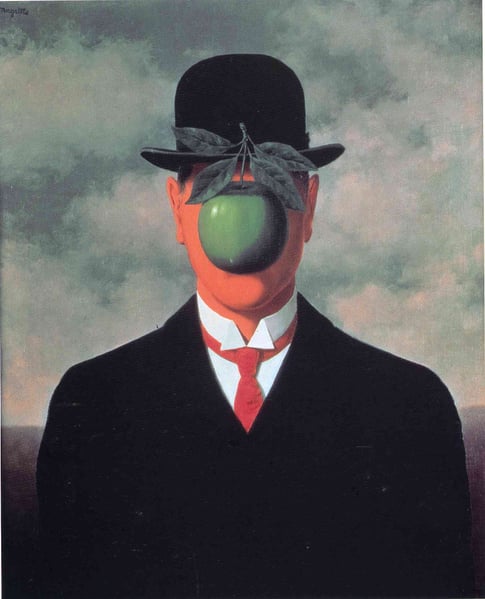
As an expert art historian, my analysis of "The Great War" by René Magritte is drawn strictly from the supplied facts: it is a Surrealist symbolic painting from the artist’s Later Period. The significance of this work lies in how it epitomizes the mature evolution of Surrealist thought and Magritte’s unique contribution to the movement.
Context within Surrealism: Magritte’s later period is marked by a refined, almost clinical precision in his imagery, which paradoxically heightens the uncanny. Where early Surrealists relied on automatic techniques and dream-like chaos, Magritte instead used deliberate, almost academic painting to create a "visual shock." The Great War—a title that inherently invokes violence and historical scale—is likely treated not as a literal depiction of battle but as a symbolic confrontation with the irrational. In Surrealism, the "war" could refer to the clash between reality and the unconscious, or between the banal and the mysterious. Magritte often weaponized the familiar (bowler hats, apples, windows) to question perception; here, the title suggests a grand conflict translated into a quiet, unsettling symbol.
Significance of the Later Period: By the 1950s and 1960s, Magritte had fully developed his signature method: isolating objects from their contexts, placing them in impossible environments, or altering their scale. The Great War likely exemplifies this later mastery—a time when his work became more philosophical, focusing on the illusion of representation itself. The symbolic genre allows Magritte to compress a complex idea (the absurdity and terrifying absurdity of war) into a single, enigmatic image. For instance, the painting may present a mundane scene (a street, a room) invaded by an inexplicable element—a giant apple blocking a face, or a suspended rock—that silently "declares war" on logic. This is the core of Magritte’s significance: he makes the ordinary menace us without spectacle.
Symbolic Power: The choice of title—The Great War—without depicting soldiers or trenches is a quintessential Surrealist gesture. It forces viewers to consider war as a psychological state, a contradiction at the heart of civilization. In Magritte’s later period, such symbols become even more distilled: a simple image carries the weight of history and trauma. The painting’s importance lies in its ability to use Surrealist techniques—displacement, condensation, and the uncanny—to critique the very nature of "greatness" in conflict. It remains a powerful example of how later Surrealism moved from automatic expression to calculated, resonant symbolism, cementing Magritte as a philosopher of the visible.
Genre
Style
Visually similar
20 works with related composition and palette
The Son of Man
Rene Magritte
Good faith
Rene Magritte
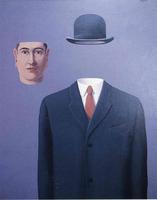
The Pilgrim
Rene Magritte
Magritte
Robert Silvers
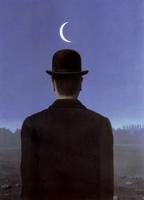
The schoolmaster
Rene Magritte
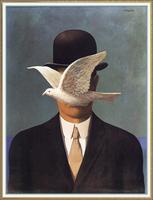
Man in a Bowler Hat
Rene Magritte
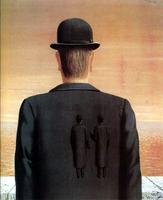
The spirit of adventure
Rene Magritte
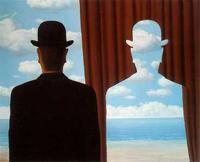
Decalcomania
Rene Magritte
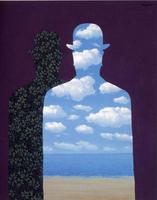
High Society
Rene Magritte
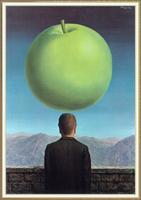
The Postcard
Rene Magritte
Not to be Reproduced
Rene Magritte
The Lovers
Rene Magritte
Satoshi Nakamoto
Gregorio Undurraga
The lovers
Rene Magritte
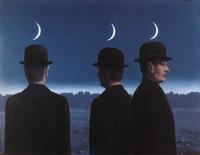
The masterpiece or the mysteries of the horizon
Rene Magritte
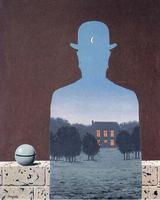
The happy donor
Rene Magritte
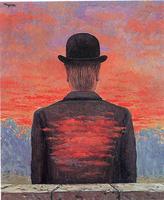
The poet recompensed
Rene Magritte
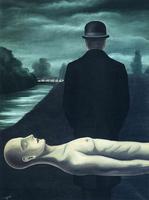
The musings of the solitary walker
Rene Magritte
Carlos Drummond de Andrade
Candido Portinari
The glass house
Rene Magritte