
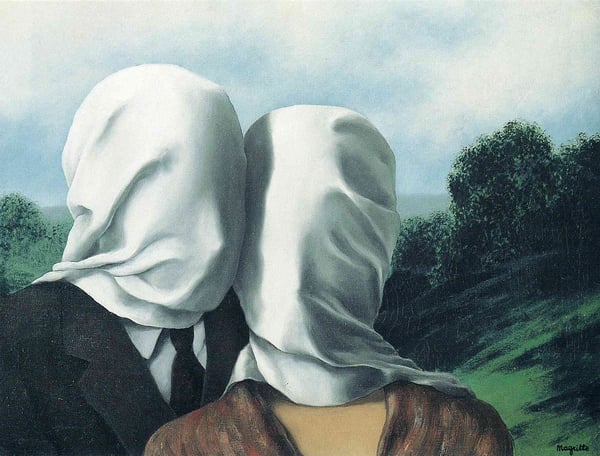
The Lovers
Details
Expert analysis of Rene Magritte’s The Lovers
Style: Surrealism · Genre: symbolic painting
Expert Analysis of "The Lovers" by René Magritte
René Magritte’s The Lovers is a seminal work of Surrealism, created during his formative Surrealist Paris years (c. 1927–1930). As a symbolic painting, it exemplifies the movement’s core ambition: to disrupt rational perception and unlock the subconscious through enigmatic, dreamlike imagery.
Significance within Surrealism:
Magritte, unlike many Surrealists who used automatic techniques, favored precise, illusionistic representation of ordinary objects recontextualized in strange ways. Here, the lovers’ faces are shrouded in white cloth—a motif that transforms a familiar romantic scene into a symbol of psychological barriers. The veils simultaneously conceal identity and heighten intimacy, forcing viewers to question the nature of connection, knowledge, and desire. This deliberate ambiguity is quintessential Surrealist: it privileges the irrational and the mysterious over literal narrative.
Genre and Period Context:
As a symbolic painting, The Lovers bypasses direct storytelling in favor of layered meaning. The cloth may represent the impossibility of truly knowing another person, the opacity of the subconscious, or the suffocating nature of love. During Magritte’s Paris years, he was deeply influenced by the Surrealist group’s interest in psychoanalysis, especially Freud’s theories of repression and the uncanny. The painting’s calm, deadpan style—flat colors, meticulous detail, domestic setting—contrasts sharply with its unsettling content, creating the disquieting harmony that defines Magritte’s mature work.
Legacy:
The Lovers remains a touchstone for Surrealist displacement of meaning. By taking everyday figures and stripping them of their usual legibility, Magritte demonstrates how symbols can bypass reason and speak directly to the psyche. This piece not only encapsulates the Surrealist Paris years’ fascination with the hidden depths of human experience but also cements Magritte’s reputation as a master of the philosophical mise-en-scène—an artist who makes the ordinary extraordinary by asking not what we see, but how we see.
Museum / Gallery
Visually similar
20 works with related composition and palette
The lovers
Rene Magritte
The Son of Man
Rene Magritte
Not to be Reproduced
Rene Magritte
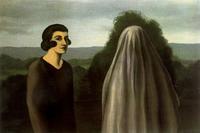
The invention of life
Rene Magritte
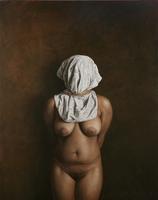
Ruth Baghead
Dan Witz
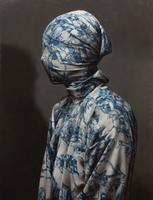
Witch Riding Backwards on a Goat
Markus Akesson
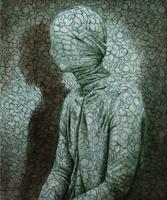
Now You See me (Green & White)
Markus Akesson
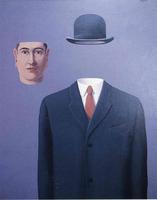
The Pilgrim
Rene Magritte
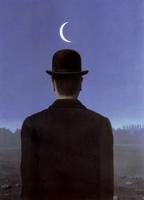
The schoolmaster
Rene Magritte
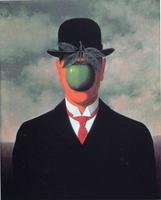
The Great War
Rene Magritte
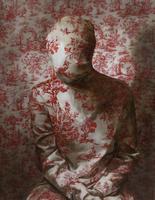
Now You See Me
Markus Akesson
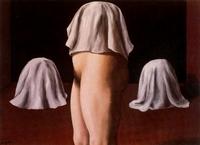
The symmetrical trick
Rene Magritte
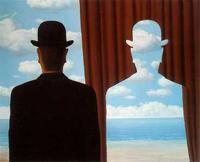
Decalcomania
Rene Magritte
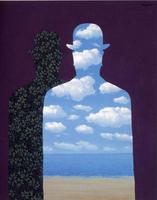
High Society
Rene Magritte
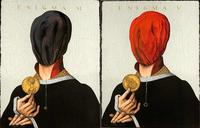
Enigma V , Enigma VI
Aydin Aghdashloo
Now You See Me (Blue and Gold Kimono)
Markus Akesson
Good faith
Rene Magritte
The Red Alert
Morteza Katouzian
The spirit of adventure
Rene Magritte
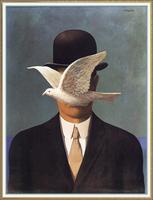
Man in a Bowler Hat
Rene Magritte