
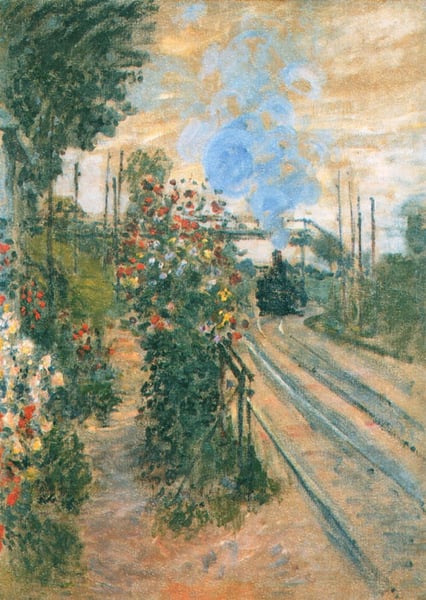
Deskundige analyse van Arriving at Montegeron van Claude Monet
Stijl: Impressionism · Genre: landscape
Expert Analysis of Arriving at Montegeron by Claude Monet
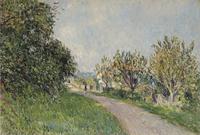
Monet’s Arriving at Montegeron is a consummate example of High Impressionism, a movement that sought to capture the fleeting effects of light and atmosphere rather than fixed, idealized scenes. The significance of this work lies in its radical treatment of a seemingly ordinary landscape—a riverside approach to the village of Montegeron—as a shimmering, unstable patchwork of color and reflection.
In true Impressionist fashion, Monet dissolves solid forms into dabs and dashes of pigment. The water of the Seine is not a blue expanse but a mosaic of violets, greens, and pale yellows, mirroring the sky and the poplars lining the bank. The horizon is deliberately low, emphasizing the interplay between water and air. Monet’s brushwork is rapid and broken, suggesting the shimmer of midday light and the gentle movement of the river’s surface.
What makes this artwork particularly significant within the Impressionist period is its demonstration of Monet’s evolving interest in serial vision and atmospheric nuance. While earlier Impressionists often painted the same motif under different conditions, Monet would later dedicate entire series to haystacks and cathedrals. Arriving at Montegeron foreshadows this serial approach: the scene is not a documentary record of a place but a sensory response to a specific moment—the angle of sunlight, the clarity of the air, the rhythm of the poplars along the path.
Moreover, the composition challenges traditional perspective. The diagonal line of the riverbank leads the eye inward, yet the reflections and scattered dabs of paint refuse to recede into deep space, maintaining the painting’s flat, fabric-like surface. This tension between illusion and materiality is a hallmark of Impressionism, and Monet’s bold color choices—such as pinkish clouds against green foliage—push the canvas toward emotional resonance rather than naturalistic fidelity.
In this single work, Monet encapsulates the Impressionist goal: to render not the object, but the visual experience of seeing. Arriving at Montegeron is thus a pivotal demonstration of how landscape painting was transformed into a record of perception itself.
Visueel vergelijkbaar
20 werken met verwante compositie en kleurenpalet
Landscape in Autumn
Gustave Loiseau
Saint-Lazare Station, Track Coming out
Claude Monet
The Western Railway at its Exit from Paris
Charles Angrand
Hill Path
Alfred Sisley
The Road in the Woods
Alfred Sisley
Rosebush in Blossom
Vincent van Gogh
Edge of Fountainbleau Forest June Morning
Alfred Sisley
The Riverbank at Petit-Gennevilliers
Claude Monet
Train in the Snow at Argenteuil
Claude Monet
On the Road from Moret
Alfred Sisley
Woman at the Garden
Pierre-Auguste Renoir
Railway Carriages
Vincent van Gogh
Lane in the Vineyards at Argenteuil
Claude Monet
House at Beynac
Gustave Loiseau
Paper Mill at Port Marly
Gustave Loiseau
Azaleas
John Henry Twachtman
Border of the Woods
Alfred Sisley
In the Garden
Claude Monet
Edge of the Fountainbleau Forest Morning
Alfred Sisley
Path near Sevres
Alfred Sisley