
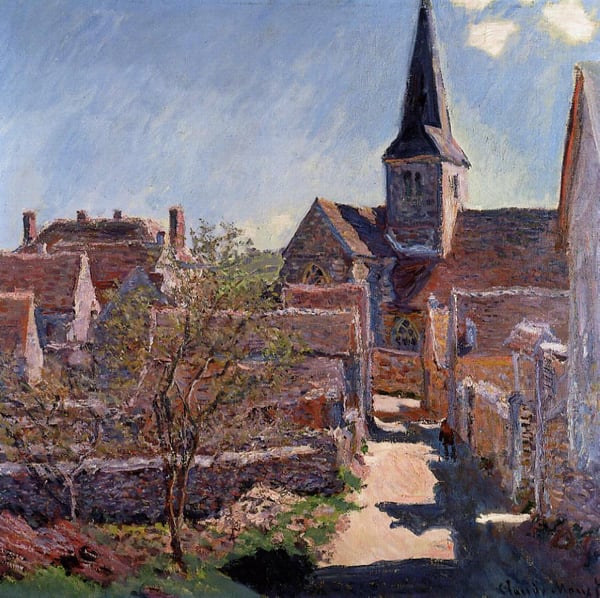
Deskundige analyse van Bennecourt van Claude Monet
Stijl: Impressionism · Genre: cityscape
Expert Analysis of "Bennecourt" by Claude Monet
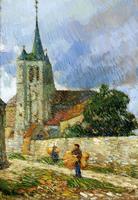
Claude Monet’s Bennecourt (often associated with his early exploration of the Seine valley) stands as a pivotal work within the Impressionist movement, specifically as a cityscape that reimagines the relationship between natural light and urban tranquility. Though the subject is a village rather than a bustling metropolis, Monet elevates this quiet riverine scene into a manifesto of Impressionist principles.
Significance within Impressionism:
-
Capturing Transient Light and Atmosphere: Monet’s handling of dappled sunlight on the water’s surface and the soft reflections of houses and foliage is a hallmark of his pursuit of en plein air spontaneity. The painting’s shimmering, broken brushwork dissolves hard edges, making the “city” of Bennecourt feel as fluid and mutable as the river itself. This technique directly challenges the academic tradition of carefully delineated forms, asserting that perception of a scene is as important as its physical reality.
-
Subversion of the Traditional Cityscape: Unlike the heroic, classical city views of Canaletto or the precise topographical records of earlier painters, Monet’s Bennecourt treats the village as a study in color and light. The buildings are not rendered with architectural rigidity; instead, they become patches of blue, ochre, and green that vibrate against the atmospheric haze. This approach democratizes the cityscape, finding beauty in an ordinary, everyday location rather than in monumental landmarks.
-
Early Evidence of Monet’s Series Thinking: While Monet later became famous for series like Haystacks and Rouen Cathedral, Bennecourt already hints at his obsession with capturing a single site under varying conditions. The same village appears in other works from this period (e.g., The River at Bennecourt, 1868), showing his early commitment to exploring how light and season transform a fixed subject—a core innovation of Impressionism.
Historical and Artistic Impact:
Bennecourt belongs to Monet’s formative years, just after his breakthrough Impression, Sunrise (1872), and it consolidates the movement’s radical departure from studio-based composition. The canvas’s loose, sketchlike finish was initially controversial; critics accused Monet of leaving paintings unfinished. Today, that very quality is recognized as revolutionary—a direct record of the artist’s fleeting sensory experience. In this work, the viewer is invited not to see a specific town, but to feel the warmth of the sun, the movement of the breeze, and the quiet rhythm of life along the Seine.
For these reasons, Bennecourt is significant not only as a beautiful Impressionist cityscape but as a foundational document of modern painting’s shift from narrative to perception, from object to atmosphere.
Visueel vergelijkbaar
20 werken met verwante compositie en kleurenpalet
Notre Dame de la Clarte
Gustave Loiseau
The descending street at Locronan
Maxime Maufra
Woman in a Street
Paul Serusier
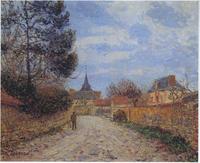
Church at Notre Dame by the Eure
Gustave Loiseau
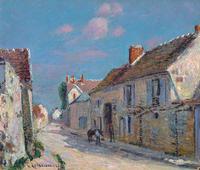
Rue a Ennery
Gustave Loiseau
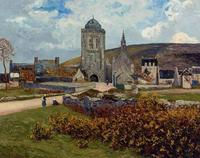
Breton Landscape
Maxime Maufra
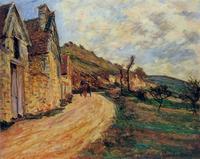
Rocks at Falaise near Giverny
Claude Monet
Street in Veneux
Alfred Sisley
The Tumbledown Cottage near Osny
Camille Pissarro
Village Street Louveciennes
Alfred Sisley
Rue de Moustier à Thorigny
Léo Gausson
The Center of La Bastide du Vert
Henri Martin
View on village of Giverny
Claude Monet
The Hamlet of Chantemesie at the Foot of the Rock
Claude Monet
Farmyard in Pontoise
Camille Pissarro
View of Auvers
Paul Cezanne
A part of Jallais, Pontoise
Camille Pissarro
View of a Farm in Osny
Camille Pissarro
The Effect of Snow at Hermitage
Camille Pissarro
Village Scene, Breton
Childe Hassam