Expertenanalyse zu Claude Monets Park Monceau 2
Stil: Impressionism · Genre: landscape
Expert Analysis of "Park Monceau 2" by Claude Monet
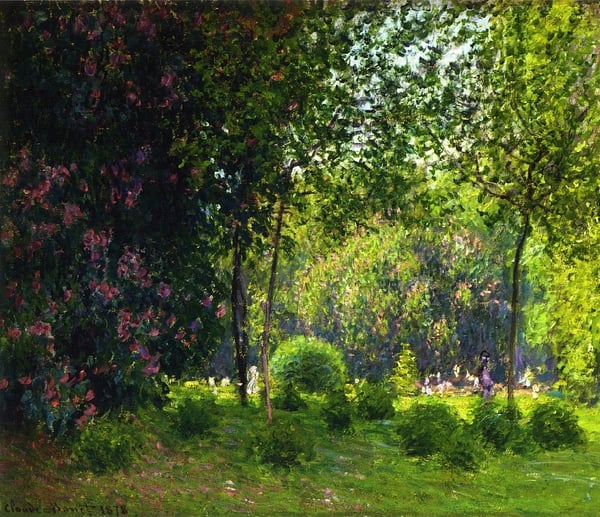
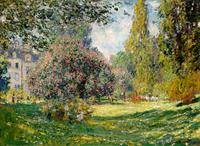
Claude Monet’s Park Monceau 2 exemplifies the core tenets of Impressionism—a movement that sought to capture the transient effects of light, atmosphere, and motion rather than static, idealized representations. Painted in the late 1870s, this landscape depicts the Parc Monceau in Paris, a fashionable and picturesque garden that Monet revisited multiple times. The work’s significance lies in how it embodies the Impressionist break from academic conventions through its handling of color, brushwork, and composition.
Composition and Subject
Monet chooses a seemingly casual, almost snapshot-like view, with a winding path drawing the eye into the depth of the park. The trees, shrubs, and figures are rendered with rapid, broken strokes that dissolve form into dappled light and shadow. This approach reflects the Impressionist interest in modern urban leisure—the park as a space of fleeting encounters and shifting daylight. Unlike traditional landscapes, there is no central focal point; instead, the entire canvas trembles with sensory immediacy.
Color and Light
Monet’s palette here is dominated by greens, blues, and touches of pink and yellow, applied in complementary contrasts to simulate sunlight filtering through leaves. He avoids black and brown in the shadows, replacing them with violet and blue—a hallmark of Impressionist color theory. The surface is built from separate touches of pure pigment, intended to blend optically in the viewer’s eye, recreating the vibrant, dissolving effect of natural light.
Brushwork and Technique
The hallmark of Park Monceau 2 is its loose, gestural brushwork. Monet uses short, comma-like strokes for foliage and longer, fluid ones for the path and sky. This technique not only conveys the shimmer of leaves but also suggests the tempo of modern life—a world in perpetual flux. The paint is applied in thick impasto in some areas, adding a tactile quality that reinforces the spontaneity of the artist’s observation.
Significance within Impressionism
This painting is significant because it demonstrates Monet’s commitment to serial exploration—a practice he later perfected with his haystacks and water lilies. By painting Parc Monceau multiple times (as indicated by “2” in the title), he investigates how the same scene transforms under different times of day and weather conditions. Moreover, the work is a record of the new Parisian boulevard culture, intertwining nature with urban modernity. It rejects narrative or moral lessons, focusing purely on visual sensation. Park Monceau 2 thus stands as a vibrant example of Impressionism’s revolutionary aim: to paint not the object itself, but the light that reveals it.
Visuell ähnlich
20 Werke mit ähnlicher Komposition und Farbpalette
In the Garden
Claude Monet
The Garden
Claude Monet
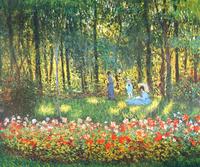
The Artist's Family in the Garden
Claude Monet
In the Park
Konstantin Makovsky
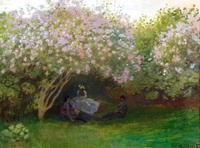
Lilacs, Grey Weather
Claude Monet
Poplars, Afternoon in Eragny
Camille Pissarro
Scheiber Hugó , Parkrészlet,
Scheiber Hugó
The Garden at Eragny
Camille Pissarro
Girl by a Fountain
Henri Martin
Park Monceau, Paris
Childe Hassam
Park Monceau, Paris
Claude Monet
Woman with a Parasol in the Garden in Argenteuil
Claude Monet
A Valencian Garden
Joaquín Agrasot
Landscape
Pierre-Auguste Renoir
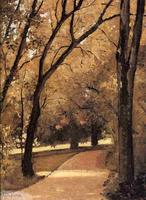
Yerres, Path Through the Old Growth Woods in the Park
Gustave Caillebotte
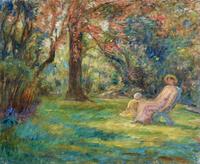
Famille dans le jardin
Marie Duhem
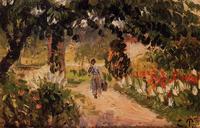
Garden at Eragny
Camille Pissarro
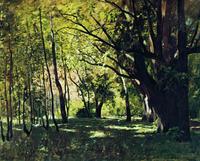
In the park
Isaac Levitan
El Retiro, Madrid
Joaquín Sorolla
The Etang des Soeurs at Osny
Paul Cezanne