
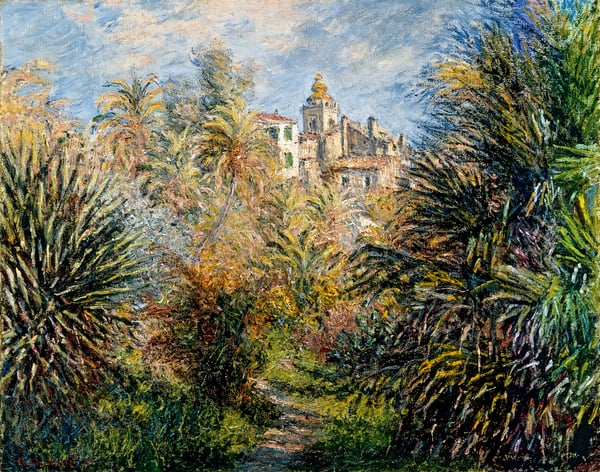
Expertenanalyse zu Claude Monets The Moreno Garden at Bordighera
Stil: Impressionism · Genre: landscape
Expert Analysis: The Moreno Garden at Bordighera (1884) by Claude Monet
This painting is a quintessential example of Claude Monet’s mature Impressionist practice, created during a pivotal journey to the Italian Riviera in early 1884. Bordighera, with its lush Mediterranean vegetation and intense sunlight, offered Monet a new chromatic challenge—one that pushed his handling of light, color, and atmosphere beyond the limits he had explored in northern France.
Significance within Impressionism:
- Radical color and light: Monet referred to Bordighera’s light as “fairy-like” and “barbaric.” In The Moreno Garden, he abandons local color for dense, vibrating strokes of emerald, cobalt, magenta, and rose. The garden becomes a shimmering tapestry where shadows are not brown or black but layered with blues, violets, and greens—a hallmark of Impressionist optical mixing.
- Loose, expressive brushwork: The painting’s surface is built from short, dappled strokes that refuse to define rigid forms. Palm fronds dissolve into flickers of green and gold; flowers blur into patches of warm hues. This technique emphasizes the sensation of the scene—the shimmer of heat, the breeze, the momentary flash of sunlight—over topographical accuracy.
- Serial exploration of a motif: Though best known for his haystacks and cathedrals, Monet painted dozens of canvases in Bordighera, often working on several at once to capture changing conditions. The Moreno Garden belongs to this intense serial process, demonstrating his obsessive study of how light transforms a single landscape across different times of day.
Art-historical context: Bordighera represented a turning point. The extreme luminosity of the Mediterranean forced Monet to use unprecedentedly bright, unblended pigments directly from the tube. This trip foreshadows his later work at Giverny, where he would orchestrate his own garden as a living palette. Here, the Moreno Garden—with its dense, almost chaotic profusion of flowers and palms—prefigures the immersive, color-saturated environments of his Water Lilies.
Why it matters: The Moreno Garden at Bordighera is not merely a pretty view; it is a laboratory of Impressionist innovation. It shows Monet grappling with the challenge of painting air as much as objects, and it exemplifies the movement’s core belief: that the true subject of painting is not the thing seen, but the ever-changing act of seeing itself.
Visuell ähnlich
20 Werke mit ähnlicher Komposition und Farbpalette
The Valley of Sasso, Bordighera
Claude Monet
Villas at Bordighera 03
Claude Monet
The Valley of Sasso
Claude Monet
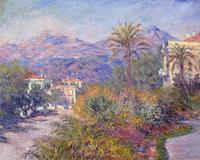
Strada Romada in Bordighera
Claude Monet
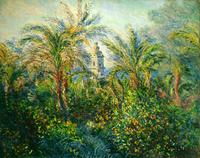
Garden in Bordighera, Impression of Morning
Claude Monet
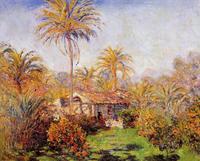
Small Country Farm in Bordighera
Claude Monet
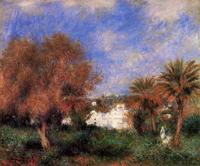
The Garden of Essai in Algiers
Pierre-Auguste Renoir
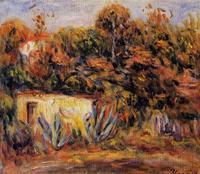
Cabin with Aloe Plants
Pierre-Auguste Renoir
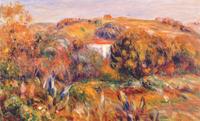
Landscape at cagnes
Pierre-Auguste Renoir
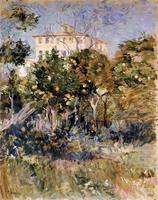
Villa with Orange Trees, Nice
Berthe Morisot
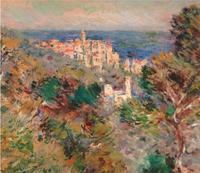
View of Bordighera
Theodore Robinson
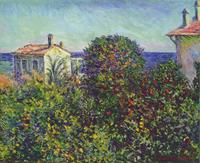
Bordighera, the House of Gardener
Claude Monet
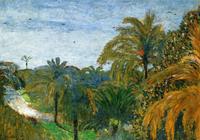
Garden in Cannes
Edouard Vuillard
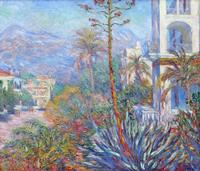
Villas at Bordighera
Claude Monet
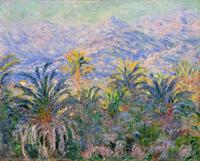
Palm Trees at Bordighera
Claude Monet
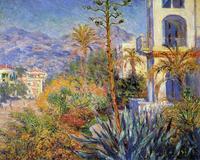
Villas at Bordighera
Claude Monet
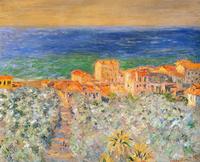
Burgo Marina at Bordighera
Claude Monet
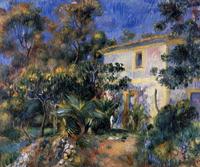
Algiers Landscape
Pierre-Auguste Renoir
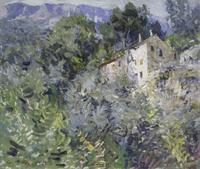
In the south of France
Konstantin Korovin
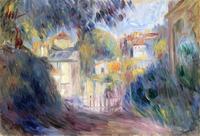
Landscape with Red Roofs
Pierre-Auguste Renoir