
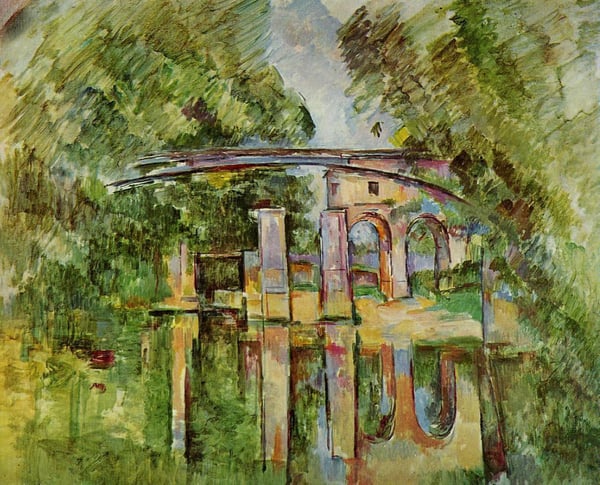
Paul Cezanne sanatçısının The Aqueduct and Lock eseri hakkında uzman analizi
Tarz: Post-Impressionism · Tür: landscape
Expert Analysis: The Aqueduct and Lock by Paul Cézanne
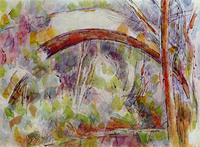
Cézanne’s The Aqueduct and Lock is a quintessential work from his mature Post-Impressionist period, a time when he decisively moved beyond the fleeting effects of Impressionism to forge a new, structural language of painting. This landscape, depicting an engineered waterway amid a Provençal setting, exemplifies Cézanne’s revolutionary approach to form, space, and color—principles that would later catalyze Cubism and modern art.
Significance within the Mature Period
By the 1880s–1890s, Cézanne had abandoned the atmospheric haze of early Impressionism. In The Aqueduct and Lock, he treats the scene not as a transient slice of nature but as a stable, architectonic arrangement. The aqueduct and lock—man-made elements—are integrated into the landscape with the same geometric rigor he applied to mountains and trees. This reflects Cézanne’s enduring goal: to “make of Impressionism something solid and enduring, like the art of the museums.”
Structural Deconstruction
The composition is built from interlocking planes and simplified volumes. The aqueduct’s arches are reduced to cylindrical forms; the lock’s rectangular basin and the distant hills are compressed into faceted planes. Cézanne deliberately flattens perspective, tilting the ground plane upward so that every element—water, masonry, foliage—exists on a single pictorial surface. This flattening, paired with his trademark constructive brushstroke (parallel, hatched marks that model form without blending), creates a tension between illusionistic depth and two-dimensional design.
Color as Form
Color is not descriptive but structural. Cool blues, greens, and ochres are woven together in a disciplined patchwork. The lock’s reflections are painted with the same opaque, unblended strokes as the stonework, denying water’s conventional transparency and instead forcing the entire canvas to resonate as a unified fabric of hue. This “color-modulation” technique—where adjacent touches of paint build volume through contrast—anticipates Picasso and Braque’s analytic Cubism.
Legacy and Influence
The Aqueduct and Lock is significant because it demonstrates Cézanne’s mature insistence on sensation over imitation: he recorded not what the eye sees, but what the mind knows about structure. The aqueduct, a motif of human intervention, becomes a metaphor for Cézanne’s own artistic method—imposing order on nature’s flux. Works like this directly inspired the radical spatial experiments of the early 20th century, marking Cézanne as the “father of modern painting.”
In this serene yet monumental landscape, Cézanne transforms a humble hydraulic feature into a timeless meditation on perception, geometry, and the materiality of paint itself.
Museum / Gallery
Görsel olarak benzer
İlişkili kompozisyon ve renk paletine sahip 20 eser
Le Petit Pecheur
Henri Matisse
Mill on the Marn, Creteil
Auguste Herbin
The River
Andre Derain
Tarnovo
Nikola Tanev
Bridge
Oleg Holosiy
The Bridge at Chatou
Maurice de Vlaminck
High Bridge. Winter
Ernest Lawson
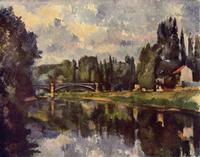
Bridge over the Marne
Paul Cezanne
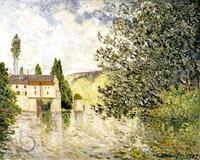
The Old Mill, The Andelys
Maxime Maufra
Fauve
Alfred Freddy Krupa
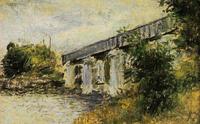
Railway Bridge at Argenteuil
Claude Monet
The Arno in Rovezzano
Odoardo Borrani
The Bridge at Maincy
Paul Cezanne
Bridge in Nara. The wind.
Pyotr Konchalovsky
Moret
Armand Guillaumin
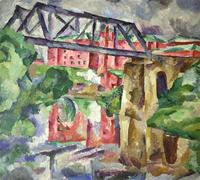
Factory in Nara
Pyotr Konchalovsky
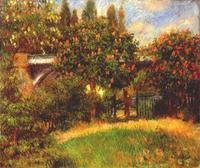
Railway Bridge at Chatou
Pierre-Auguste Renoir
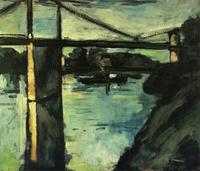
The Pont de Chatou
Maurice de Vlaminck
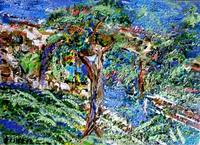
A ponte, praia fluvial de Burgães
Paulo Fontes
River at the bridge of the three sources
Paul Cezanne