
Description
Style: Baroque, Tenebrism · Genre: self-portrait
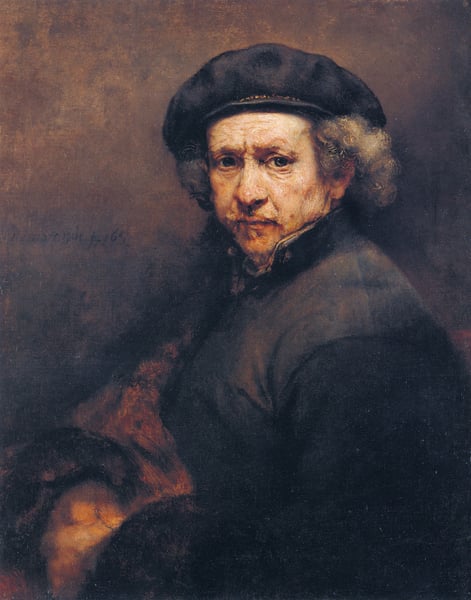
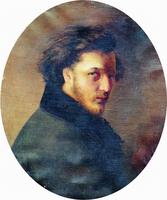
This self-portrait depicts the artist, wearing a beret and a fine coat with upturned collar, his body in three quarter profile view, as he faces the viewer with a complex gaze. His slightly furrowed brow and deep-set eyes convey resolute strength and intensity, while the light, illuminating his face in rich variations of flesh tones with touches of pink, evokes vitality. The painting is strongly composed, his form a pyramid emphasized by the glow upon his left shoulder and his lit up clasped hands, rendered somewhat impressionistically. The brown background, though dark, is atmospherically rich and varied and counterpoints the darker tones of his coat. He seems to be surrounded by a kind of gravity that both emphasizes his illuminated face and adds an air of dignity.
Rembrandt had come to near financial ruin in 1659, as the previous year his house and possessions had been auctioned to pay his creditors, and the brooding quality of this work while reflecting, perhaps, the profound self-assessment that followed, is simultaneously a statement of artistic mastery. In 1639 Rembrandt encountered Raphael's Balthasar Castiglione (1514-1515), a noted portrait of the Humanist scholar, known as an ideal representative of High Renaissance "nonchalant mastery." Subsequently, Rembrandt made several sketches of the work, as well as an etching Self-portrait Leaning on a Stone Sill (1639), portraying himself in a similar pose, wearing a similar, but more contemporary, beret and dark clothing. This work becomes, in effect, Rembrandt's reply to the High Renaissance.
Rembrandt was the Dutch Golden Age's greatest portraitist, and almost modern in his emphasis on self-portraits, painted continually throughout his career. He influenced van Gogh and Rodin and had a noted impact on the 20th century influencing Frank Auerbach, who praised what he called the artist's "raw truth," and Francis Bacon. As art historian Pilar Ordovas noted, "Rembrandt was crucial to Bacon in terms of mark-making and the handling of paint." In this late work, his brushwork is loose and almost Impressionistic, as art critic Mark Hudson wrote, "Yet it is also the trajectory we expect art to take: away from tightness, order and control, towards expressivity and abstraction. As Rembrandt invents himself in paint, so he invents Modern Art as he goes."
Museum / Gallery
Genre
Visually similar
20 works with related composition and palette
Self-portrait
Rembrandt
Self-portrait with beret and turned up collar
Rembrandt
Self-portrait
Rembrandt
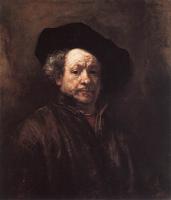
Self-portrait
Rembrandt
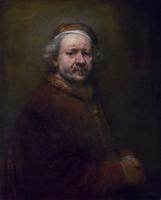
Self-portrait in at the Age of 63
Rembrandt
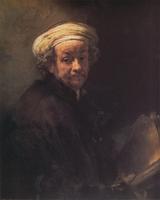
Self-portrait as the Apostle Paul
Rembrandt
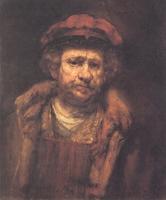
Self-portrait
Rembrandt
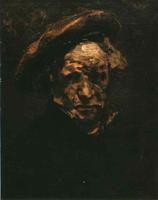
Self-portrait
Rembrandt
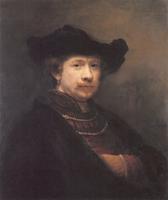
Self-portrait
Rembrandt
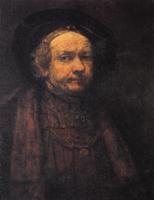
Self-portrait
Rembrandt
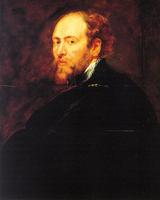
Self-Portrait
Peter Paul Rubens
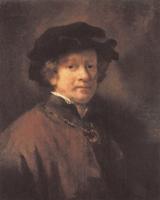
Self-portrait
Rembrandt
Old man Dressed as Saint Paul
Rembrandt
Self-portrait
Alfred Dehodencq
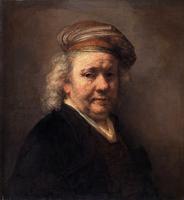
Self-portrait
Rembrandt
Self-portrait
Eugene Delacroix
Self-portrait
Rembrandt
Portrait of Thomas Reid
Henry Raeburn
Young Spanish gentleman
Diego Velazquez
Portrait of Artist K.Bornikov
Konstantin Makovsky