
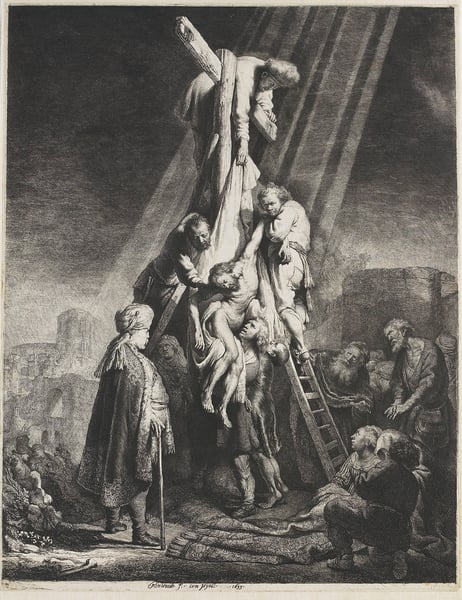
Expertenanalyse zu Rembrandts The descent from the cross
Stil: Baroque · Genre: religious painting
Expert Analysis of "The Descent from the Cross" by Rembrandt
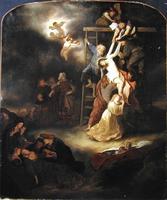
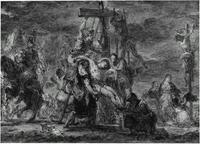
As a masterwork of the Baroque style and a deeply moving religious painting, Rembrandt’s “The Descent from the Cross” achieves its significance through a radical synthesis of emotional realism and theatrical light—hallmarks of the Baroque period.
Baroque Innovation: Light and Drama The Baroque era prized dynamic composition, intense chiaroscuro (strong contrast between light and dark), and the evocation of raw human emotion. Rembrandt amplifies these principles by focusing the scene’s illumination not on a triumphant Christ, but on the tender, sorrowful moment of his removal from the cross. The light falls diagonally across the pale, lifeless body, tracing the hands and face of Christ, while the surrounding figures are partially submerged in shadow. This use of tenebrism (extreme light-shadow contrast) creates a hushed, almost sacred intimacy, pulling the viewer into the grief-stricken narrative. Unlike the more theatrical, sweeping diagonals of many Baroque altarpieces, Rembrandt’s composition is compact and human-scaled, with the cross acting as a vertical anchor around which the mourners cluster in a quiet, weighty pyramid—a powerful, understated counterpoint to the era’s typical exuberance.
Significance as a Religious Painting As a religious painting, the work transgresses traditional devotional norms. Instead of depicting a distant, heroic Savior, Rembrandt presents a thoroughly human Christ—limp, heavy, and fragile—whose descent is handled with palpable physical effort and tenderness by Mary, John, and the other figures. Their faces are not idealized; they show the exhaustion, tears, and solemn gravity of real mourners. This humanization of the sacred narrative allowed Baroque artists to make theological mysteries accessible through pathos and naturalism. The painting’s significance lies in how it transforms the canonical biblical scene into a universal meditation on loss, compassion, and the dignity of the human body in death—a break from earlier, more hieratic treatments.
In essence, “The Descent from the Cross” is significant because it embodies the Baroque capacity to marry theatricality with raw human vulnerability, using light and shadow not merely as decoration but as the very language of spiritual revelation. Rembrandt’s genius here is in making a monumental, religious subject feel like a quiet, private bereavement—one that resonates across centuries.
Visuell ähnlich
20 Werke mit ähnlicher Komposition und Farbpalette
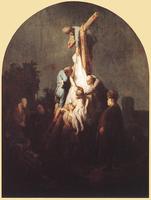
Deposition from the Cross
Rembrandt
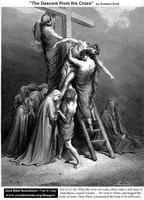
The Descent From TheCross
Gustave Dore
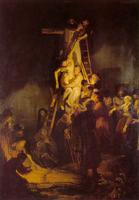
The Descent from the Cross
Rembrandt
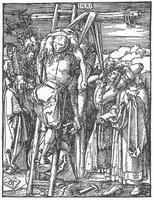
The Descent from the Cross
Albrecht Durer
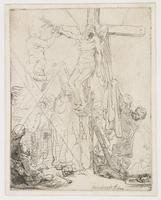
The descent from the cross
Rembrandt
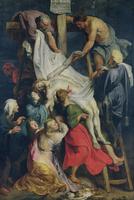
Descent from the Cross
Peter Paul Rubens
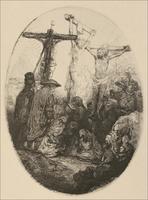
The Crucifixion an Oval Plate
Rembrandt
The Descent from the Cross
Salomon Koninck
Christ crucified between the two thieves an oval plate
Rembrandt
Descent from the Cross (centre panel)
Peter Paul Rubens
Lamentation Over Christ
Albrecht Durer
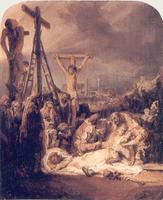
The Lamentation over the Dead Christ
Rembrandt
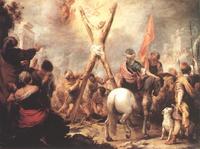
The Martyrdom of St. Andrew
Bartolome Esteban Murillo
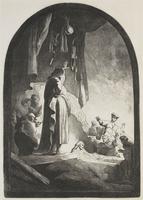
The raising of Lazarus
Rembrandt
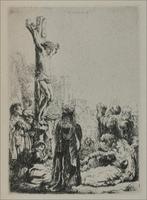
The Crucifixion a Square Small Plate
Rembrandt
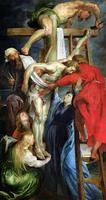
The Descent from the Cross
Peter Paul Rubens
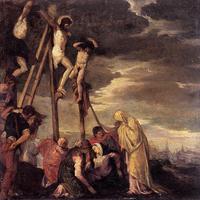
Calvary (after Veronese)
Berthe Morisot
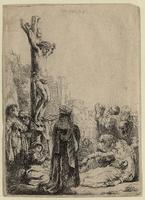
The tribute money
Rembrandt
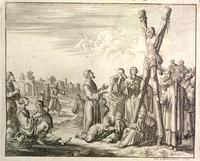
Crucifixion of Apostle Andrew, Patras in Achaia, AD 70
Jan Luyken
The Descent from the Cross
Eugene Delacroix