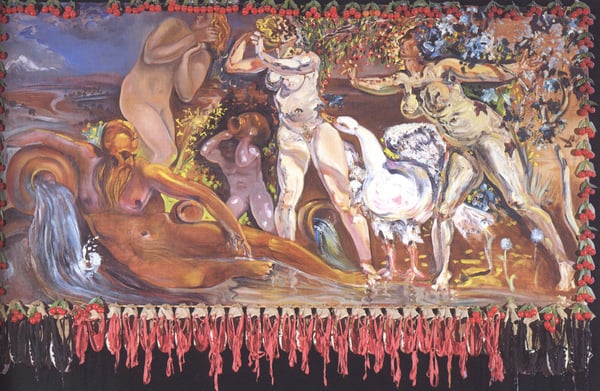
Analisi esperta di Allegory of Spring di Salvador Dali
Stile: Neoclassicism, Surrealism · Genere: allegorical painting
Expert Analysis of Salvador Dalí's Allegory of Spring
Salvador Dalí’s Allegory of Spring stands as a pivotal work from his Classic Period (1941–1989), a phase when the artist famously declared a return to the “classical” tradition while never abandoning his surrealist roots. The painting masterfully fuses Neoclassicism and Surrealism, two seemingly opposing styles, into a single allegorical vision.
Significance within the Classic Period:
After his break with the Surrealist movement in the 1940s, Dalí embraced what he called “Nuclear Mysticism” and a renewed interest in Renaissance composition and perspective. Allegory of Spring exemplifies this shift: its formal structure—balanced, pyramidal groupings, atmospheric depth, and idealized figures—echoes the Renaissance and Neoclassical masters such as Raphael and Ingres. Yet the subject matter remains unmistakably Surrealist, populated by melting forms, dreamlike juxtapositions, and psychological symbolism.
Style and Genre:
As an allegorical painting, the work uses personification and symbolic imagery to explore themes of rebirth, fertility, and the cyclical nature of time—the title itself evokes Botticelli’s Primavera, but Dalí subverts the classical pastoral with his trademark uncanny details. The Neoclassical elements (sculptural drapery, classical architecture in the background, harmonious color palette) provide a rigorous framework that anchors the Surrealist elements (distorted anatomy, floating objects, unexpected dislocations). This synthesis makes the painting significant as a bridge between Dalí’s early avant-garde experimentation and his later, more academic mysticism.
Art Historical Importance:
Allegory of Spring is a key demonstration of Dalí’s belief that Surrealism could be reconciled with tradition—a controversial stance that alienated some contemporaries but eventually redefined his legacy. The painting’s technical precision (sharp focus, smooth brushwork) and layered iconography (classical springs, surrealist metamorphosis) represent the artist’s mature ambition to create a “paranoiac-critical” reinterpretation of European art history. It is not merely a revival of Neoclassical style, but a surrealist deconstruction of it, making the work essential for understanding Dalí’s evolution and the broader trajectory of 20th-century art.
Visivamente simili
20 opere con composizione e palette affini
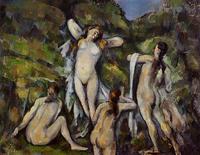
Four Bathers
Paul Cezanne
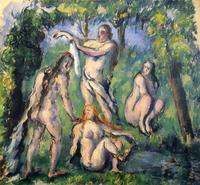
Four Bathers
Paul Cezanne
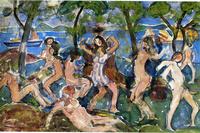
Bathers
Maurice Prendergast
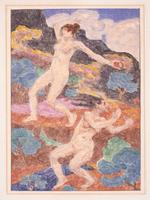
Phantasy
Rupert Bunny
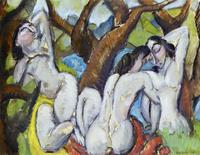
Three Nudes in a Forest
Max Weber
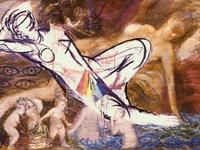
Am I Susanna
Dmytro Kavsan
Reflecting pool
Marcel Gromaire
Three Nudes
August Macke
Three Bathers
Paul Cezanne
Bathing women
Andre Derain
Double Nude: Two Women
Oskar Kokoschka
The Rejected Lover
Oskar Kokoschka
Nudes in a Landscape
Ion Theodorescu-Sion
Three nudes
Pablo Picasso
Narcissus and the nymph Echo. Etude
Zinaida Serebriakova
Diana and Actaeon
Zinaida Serebriakova
Temptation
Othon Friesz
Study of Bathers
Paul Cezanne
Untitled
Paul Ranson
Effloration
Austin Osman Spare