Analisi esperta di Four Armchairs in the Sky di Salvador Dali
Stile: Surrealism · Genere: landscape
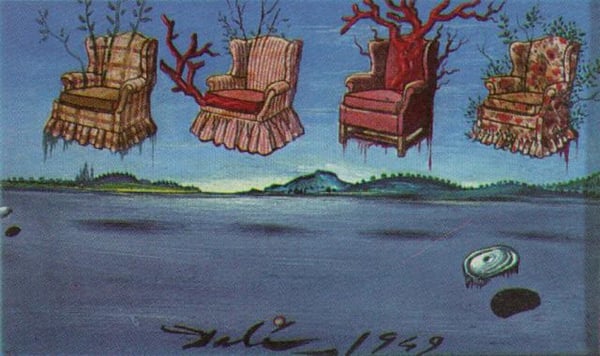
Expert Analysis of Salvador Dalí’s "Four Armchairs in the Sky" (Classic Period, 1941–1989)
This work belongs to Dalí’s Classic Period, a phase marked by a return to meticulous realism and technical virtuosity, often infused with scientific, religious, or optical themes. As a Surrealist landscape, it exemplifies the movement’s core mission: to disrupt the mundane by placing familiar objects in impossible contexts.
Significance within Surrealism and Dalí’s Evolution:
-
Dislocation and Dream Logic: The central motif—four armchairs suspended in a vast sky—is a textbook Surrealist device. By removing domestic furniture from its terrestrial context and floating it in an ethereal void, Dalí creates a disturbing, poetic incongruity. The armchairs, symbols of human comfort and stasis, become uncanny, weightless objects, inviting the viewer to question the boundary between the real and the imagined.
-
Landscape as a Psychological Stage: Though classified as a landscape, the canvas is far from a naturalist view. The sky, likely rendered with Dalí’s characteristic hyper-realistic precision, serves as an empty theater for the unconscious. This aligns with Surrealism’s interest in the “irrational” and the “marvelous,” where everyday items are transformed into psychic symbols.
-
Period Signature: During Dalí’s Classic Period, he increasingly merged Renaissance-style clarity with bizarre subject matter. Here, the armchairs are painted with meticulous detail—fabric folds, wooden legs, shadows—heightening the tension between reality and fantasy. This technical mastery underscores the period’s fascination with double imagery and paranoiac-critical method, where the most recognizable objects are made alien through placement.
Why It Matters:
“Four Armchairs in the Sky” is significant as a mature statement of Dalí’s enduring Surrealist strategy: to make the impossible look inevitable. It distills the movement’s essence—transforming the ordinary into the extraordinary within a seamless, believable space. The work also reflects Dalí’s later shift toward a more controlled, classical surrealism, where the shock comes not from distortion but from the unthinkable conjunction of known forms. In this sky, the armchairs are not merely furniture; they are anchors of domestic reality uprooted into the boundless realm of the subconscious.
Visivamente simili
20 opere con composizione e palette affini
Furniture in the Valley
Giorgio de Chirico
Green Wall series No. 4
Zhang Xiaogang
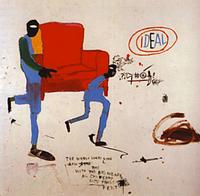
Light Blue Movers
Jean-Michel Basquiat
Night Tears. From the Album 'Florence'
Viktor Pivovarov
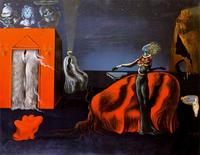
Singularities
Salvador Dali
Chair
George Bouzianis
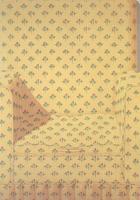
Armchair
Domenico Gnoli
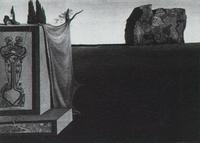
Landscape
Salvador Dali
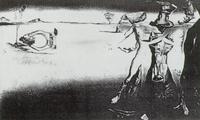
Apparition of a Couple in the Desert
Salvador Dali
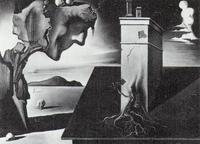
Spellbound
Salvador Dali
Unsatisfied Desires
Salvador Dali
Green Wall series No. 3
Zhang Xiaogang
Study for "Honey is Sweeter than Blood"
Salvador Dali
Figure on a folding bed
Francis Bacon
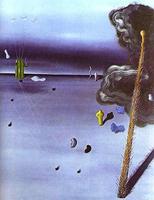
Mama, Papa is Wounded!
Yves Tanguy
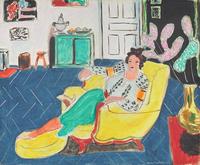
Woman Seated in An Armchair
Henri Matisse
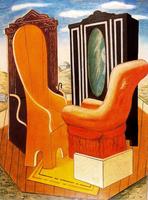
Untitled
Antonio Bueno
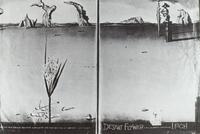
Flower in the Desert
Salvador Dali
The green ear and language thorny
HRASARKOS
Large Painting Representing a Landscape
Yves Tanguy