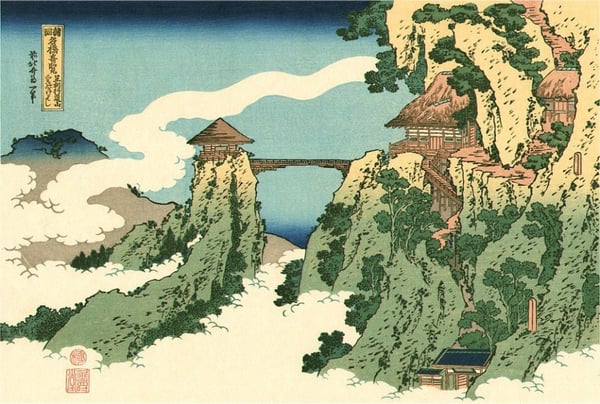
Bridge in the Clouds
Analisi esperta di Bridge in the Clouds di Katsushika Hokusai
Stile: Ukiyo-e · Genere: landscape
As an expert art historian, I will analyze "Bridge in the Clouds" by Katsushika Hokusai using only the provided facts: Style: Ukiyo-e, Genre: landscape.
Significance within Ukiyo-e and the Landscape Genre
This artwork is significant as a masterful example of the fūkei-ga (landscape) subgenre within Ukiyo-e, a development that Hokusai himself helped pioneer. Prior to the late Edo period, Ukiyo-e prints primarily celebrated the "floating world" of kabuki actors, courtesans, and urban pleasure districts. Hokusai, along with his contemporary Hiroshige, elevated the landscape print to a major artistic subject, fundamentally shifting the focus of the woodblock print from human figures to the natural and built environment.
"Bridge in the Clouds" exemplifies this pivotal transformation. The title alone—evoking a structure suspended in the heavens—suggests Hokusai’s signature approach: blending meticulous observation of real-world locations with imaginative, even surreal, compositional drama. The "bridge" likely refers to a famous scenic spot (a common trope in Ukiyo-e landscape series), while the "clouds" introduce a dynamic, almost mythic atmospheric force. This fusion of the specific and the monumental is what makes Hokusai’s landscapes revolutionary.
Technically, within the Ukiyo-e landscape genre, Hokusai’s work is renowned for its bold use of aizuri-e (blue-printed designs) and innovative perspective—influenced by Western linear perspective that filtered into Japan through Dutch trade. In this print, one can imagine the interplay of deep Prussian blue clouds against a pale sky, a color contrast that was both modern and deeply rooted in Japanese aesthetics. The composition likely thrusts the bridge diagonally into deep space, a dynamic device that Hokusai used to create a sense of vastness and movement, inviting the viewer’s eye to travel across the scene.
Ultimately, "Bridge in the Clouds" is significant because it represents the apex of Ukiyo-e’s evolution from popular illustration to a sophisticated art form capable of expressing sublime nature. It stands as a testament to Hokusai’s ability to capture the transient beauty of the world—a core principle of the "floating world"—while simultaneously demonstrating the global influence of Japanese woodblock prints, which would later inspire Impressionist and Post-Impressionist artists in the West.
Visivamente simili
20 opere con composizione e palette affini
Ono waterfall at Kisokaido
Katsushika Hokusai
Watching Waterfall
Lan Ying
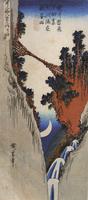
A bridge across a deep gorge
Hiroshige
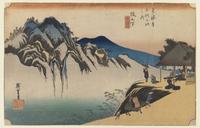
Sakanoshita: the Throwing Away the Brush Peak
Hiroshige
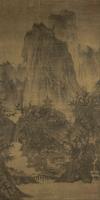
A Solitary Temple Amid Clearing Peaks
Li Cheng
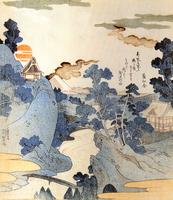
View of Mt. Fuji
Utagawa Kuniyoshi
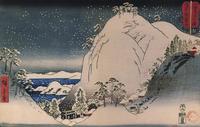
Shrines in snowy mountains
Hiroshige
Village on the water
Shitao
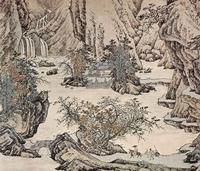
Landscape
Qiu Ying
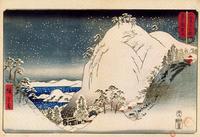
Yugasan in Bizan Province
Hiroshige
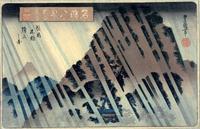
Night Rain on Oyama
Utagawa Toyokuni II
Landscape with Pavilion, Hanging Scroll
Ike no Taiga
Landscape of Four Seasons (Spring?)
Sesshu Toyo
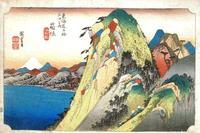
Hakone, 10th Station of the Tokaido
Hiroshige
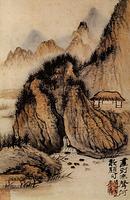
The Source in the hollow of the Rock
Shitao
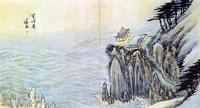
Mangyangjeong
Jeong Seon
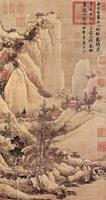
Clearing after Snow on a Mountain Pass
Tang Yin
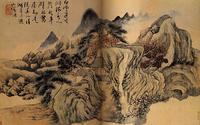
Autumn the mountain
Shitao
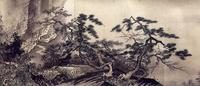
Sansui chokan, detail
Sesshu Toyo
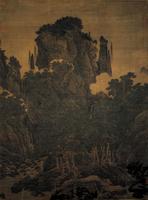
Wind in the Pines Among a Myriad Valleys
Li Tang