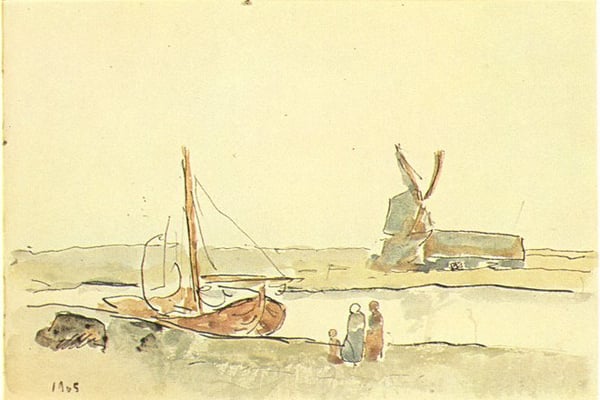
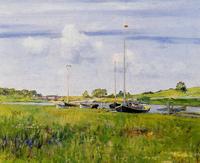
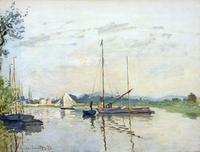
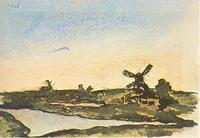
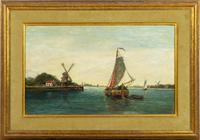
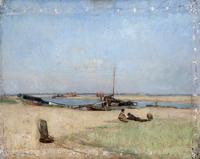
This landscape from Picasso's Rose Period exemplifies a transitional moment within Post-Impressionism. Executed in warmer, more buoyant tones than his earlier Blue Period, "A boat on the canal" captures a serene, everyday scene—a canal boat—through simplified forms and a flattened perspective typical of Post-Impressionist spatial experimentation. Its significance lies in how Picasso adopts the movement's emphasis on emotional resonance and structural harmony, infusing a humble subject with the delicate lyricism that defines his Rose Period. The work stands as a rare landscape from a phase better known for harlequins and acrobats, showcasing Picasso's versatility and his early departure from naturalistic representation toward the symbolic, expressive distillation that would later evolve into Cubism.