Dream and Lie of Franco
Dettagli
Analisi esperta di Dream and Lie of Franco di Pablo Picasso
Stile: Surrealism · Genere: symbolic painting
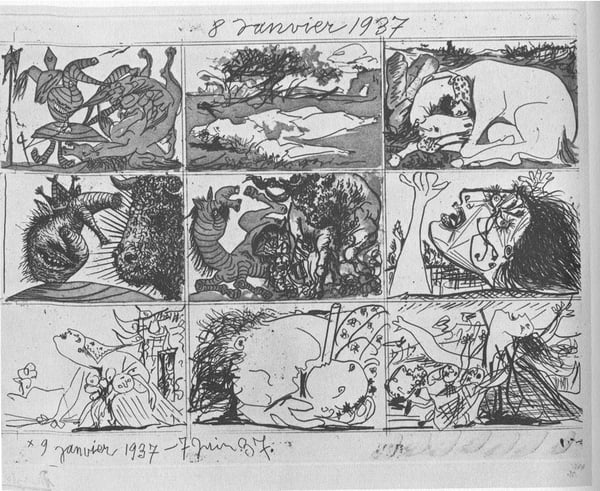
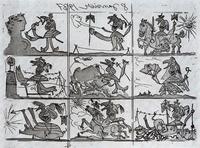
The Dream and Lie of Franco (1937) by Pablo Picasso stands as a defining fusion of Surrealist technique and urgent political commentary. Executed as a series of 14 miniature etchings (plus a final framing plate) accompanied by a surrealist prose poem, it is a blistering, symbolic attack on Francisco Franco’s regime. Created in the months just before Picasso’s monumental Guernica, this suite serves as both a preliminary sketch for that larger work and a distinct, self-contained masterpiece of propaganda and nightmare.
Significance within Surrealism and its Period
-
Surrealist Morphing and Political Allegory
Picasso deploys the quintessential Surrealist strategy of metamorphosis: Franco’s body fragments into floppy, phallic shapes, a bull-headed monster, a screaming horse, and a grotesque caricature of a Spanish grandee. These shifting, biomorphic forms channel the revolutionary side of Surrealism—making the subconscious visible—but here that free-associative language is weaponized against a specific political target. The dream of the title is not a personal reverie but a collective nightmare of fascist oppression. -
Narrative Sequence as a Visual Poem
Unlike a traditional painting, the 14 small panels unfold in a cinematic sequence, mimicking a filmstrip or a comic strip—a format Picasso would later revisit. The work functions as a printed political broadside, cheaply reproducible and meant for distribution. This hybrid of high-art etching, Surrealist poetry, and mass-media satire is a signature achievement of Picasso’s Neoclassicist & Surrealist Period, demonstrating his ability to merge classical draftsmanship with radical avant-garde form. -
Precursor to Guernica
The horse’s shrieking head and the weeping female figures that appear here become central icons in Guernica. The Dream and Lie of Franco thus marks the moment when Picasso’s Surrealist vocabulary—born in the 1920s—fully confronts the twentieth century’s most brutal political reality. Its significance lies in proving that Surrealism, often dismissed as escapist, could be a razor-sharp tool of resistance.
In sum, this work is significant because it radicalizes Surrealism’s dream logic into a direct, symbolic indictment of Franco, while also foreshadowing the iconic imagery of Guernica. It exemplifies how Picasso—during his Neoclassicist & Surrealist Period—could wield the absurd and the grotesque to expose the lie of authoritarian power.
Visivamente simili
20 opere con composizione e palette affini
Untitled (This Poster is the Story of Change … )
Carlos Almaraz
Abst. 2 de 03
Jacques Wadier
Mirror Workshop
Pierre Alechinsky
But Where Are They? (Mais où sont-ils?)
Pierre Alechinsky
Studies of Monsters
Hieronymus Bosch
Discovery of Acid (Act II) [Découverte de l'acide (acte II)]
Pierre Alechinsky
Dream and Lie of Franco
Pablo Picasso
Plate II from the portfolio Vulcanologies
Pierre Alechinsky
Title Page
Max Slevogt
Y.I.P. Miami
Oyvind Fahlstrom
Sketch of a Tree against Clouds with Colour Annotations
Vincent van Gogh
A Page By Ad Reinhardt
Ad Reinhardt
Jumbled Ephemerides
Pierre Alechinsky
Lessons
Paula Rego
Alvéoles
Pierre Alechinsky
Untitled
Jackson Pollock
Nichiren saved from the executioners sword
Utagawa Kuniyoshi
Le complexe du sphinx
Pierre Alechinsky
The heart of the circus
Marc Chagall
Paradise
Marc Chagall