
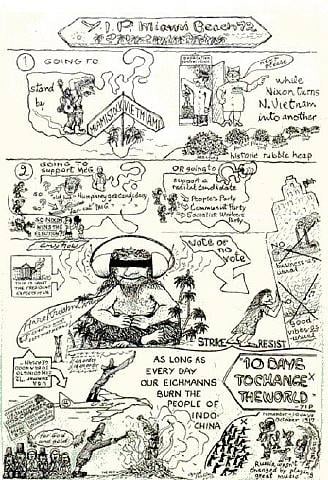
Экспертный разбор работы «Y.I.P. Miami» художника Oyvind Fahlstrom
Стиль: Neo-Dada, Pop Art · Жанр: figurative
Expert Analysis of Y.I.P. Miami by Öyvind Fahlström
Öyvind Fahlström’s Y.I.P. Miami stands as a pivotal work that bridges the irreverent assemblage of Neo-Dada and the mass-media critique of Pop Art, while retaining a distinctively figurative, narrative-driven core. The title itself—an abbreviation likely referencing the Youth International Party (the “Yippies”) and the city of Miami—anchors the piece in the turbulent political climate of the late 1960s and early 1970s, specifically the 1968 Democratic National Convention protests and the broader counterculture movement.
What makes Y.I.P. Miami significant is Fahlström’s radical synthesis. From Neo-Dada, he borrows a collage-like, often chaotic layering of disparate elements, treating the canvas as a field of signs and detritus rather than a unified pictorial space. Yet unlike the more abstract or object-oriented Dadaists, Fahlström maintains a strong figurative anchor: human forms, cartoon-like figures, and recognizable objects (weapons, flags, consumer goods) populate the composition. This figurative element is deployed not for realism but as a satirical diagram of power, exploitation, and media spectacle.
The Pop Art dimension emerges in Fahlström’s use of commercial and political iconography—logos, text fragments, comic-strip panels, and bright, flat color blocks—rendered with a graphic sensibility that mirrors advertising and news media. However, where many Pop artists (Warhol, Lichtenstein) often remained cool and detached, Fahlström injects a dense, almost didactic critique. Y.I.P. Miami is deliberately overstuffed, forcing the viewer to navigate a visual cacophony that mirrors the information overload of modern political life.
Crucially, the work is not static; Fahlström often incorporated moveable elements (magnets, cut-outs) in his pieces, inviting physical interaction. In Y.I.P. Miami, the arrangement of figurative and symbolic components suggests a game board or a mutable diagram—an open-ended commentary on the fluidity of political alliances, the absurdity of violence, and the commodification of protest. This interactive, process-oriented aspect aligns with Neo-Dada’s embrace of chance and participation, while the satirical, pop-inflected imagery keeps the work grounded in its historical moment.
In summary, Y.I.P. Miami is significant as a Neo-Dada/Pop Art hybrid that uses figurative narration to dissect contemporary politics. It exemplifies Fahlström’s unique ability to merge fine-art abstraction with cartoonish legibility, and his prescient critique of media saturation and protest culture remains startlingly relevant.
Визуально похожие
20 работ с близкой композицией и палитрой
Dream and Lie of Franco
Pablo Picasso
Untitled (This Poster is the Story of Change … )
Carlos Almaraz
Notes 7 ('Gook'-Masks)
Oyvind Fahlstrom
A Page By Ad Reinhardt
Ad Reinhardt
Bishop
Jean-Michel Basquiat
Las aventuras de Don Gil Contento
Quinterno
Sketch for a World map Part 1 (Americas, Pacific)
Oyvind Fahlstrom
Dream and Lie of Franco
Pablo Picasso
Idols
Nicholas Roerich
Titian
Jean-Michel Basquiat
Title Page
Max Slevogt
STUDY OF FARMWORKERS (RECTO); TREE STUDY (VERSO) - DinksFãStan Private Collection
Maggie Laubser
Study for World Model (Garden)
Oyvind Fahlstrom
Sower and Trunk of an Old Yew Tree
Vincent van Gogh
Column no. 1 (Wonder Bread)
Oyvind Fahlstrom
L'Arlesienne, Portrait of Madame Ginoux
Vincent van Gogh
Illustration to 'Armenian folk tales'
Martiros Sarian
The Comic Book (Series of 8 Drawings)
Jean-Michel Basquiat

Untitled
Alevtyna Kakhidze
Studies of Monsters
Hieronymus Bosch