Analisi esperta di Castle of King Mark di Nicholas Roerich
Stile: Art Nouveau (Modern) · Genere: design
Expert Analysis of "Castle of King Mark" by Nicholas Roerich
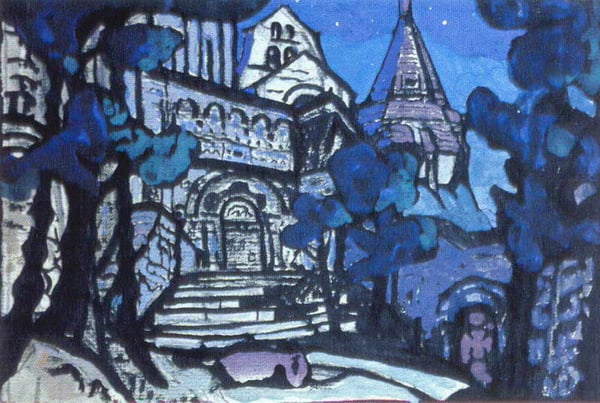
Nicholas Roerich’s “Castle of King Mark” exemplifies the designer’s role within the Art Nouveau (Modern) movement, where the boundaries between fine art, craft, and theatrical illusion dissolve. Executed as a design—likely for a stage production inspired by the Arthurian or Celtic legend of Tristan and Iseult—this work demonstrates Art Nouveau’s core ambition: to create a total, integrated aesthetic experience that unites architecture, decoration, and narrative mood.
Significance within Art Nouveau and the Modern Period
Roerich’s piece is significant for how it reimagines medievalism through the lens of Art Nouveau’s organic, flowing forms and symbolic geometry. Instead of a literal, archaeological reconstruction of a Celtic fortress, the castle becomes a rhythmic interplay of vertical towers, undulating rooflines, and flattened decorative planes—hallmarks of the Modern style. The composition emphasizes stylization over realism: the structure appears to grow from the landscape, its contours echoing the sinuous lines found in contemporary graphic arts, furniture, and metalwork.
As a design, the work is not merely a preparatory sketch but a finished statement in its own right, intended to guide the construction of stage scenery. This aligns with Art Nouveau’s democratic impulse to erase hierarchies between high art and applied design. Roerich, deeply influenced by Russian folk traditions, Symbolist theater, and the spiritual revival of ancient motifs, infuses the scene with a mystical, timeless quality. King Mark’s castle is not a specific historical site but an archetype—a dreamlike fortress that stands at the threshold of legend and modernity.
Contribution to Roerich’s Oeuvre and Period Context
Within the broader Modern period, “Castle of King Mark” showcases Roerich’s unique synthesis of Eastern and Western iconography, his fascination with the remote past, and his belief in art as a vehicle for spiritual transformation. The flat, decorative handling of color and silhouette reflects the influence of Japanese prints and European Symbolism, while the dramatic verticality anticipates the expressive architecture of later Expressionist stage design. By presenting a mythical realm through the refined, linear language of Art Nouveau, Roerich elevates commercial stage design to the level of autonomous fine art—a transformative achievement for the genre.
In sum, this artwork stands as a masterful example of Art Nouveau’s capability to channel historical narrative through modern formal innovation, and as a testament to Roerich’s visionary integration of design, legend, and aesthetic unity.
Museum / Gallery
Visivamente simili
20 opere con composizione e palette affini
Castle of King Mark
Nicholas Roerich
Castle at night
Nicholas Roerich
Untitled
Nicholas Roerich
By the sea
Nicholas Roerich
City
Nicholas Roerich
Church of Saint Lou d'Esserant in the Oise
Theodore Rousseau
The Little Chapel Chancelade
Grant Wood
Church of St. Peter on Monmartre
Maurice Utrillo
City
Nicholas Roerich
Viking's tomb
Nicholas Roerich
Ruins of Montmajour
Vincent van Gogh
Arch from the Façade of the Church of San Michele
John Ruskin
Cluny Illustration
Constant Le Breton
Pisa as intended
Ben Nicholson
Methodist Chapel
Frances Hodgkins
St Julien Pauvre
Bela Czobel
In the ancient city
Konstantin Korovin
Yaroslavna's Lament
Konstantin Korovin
Houses at Ceret
Chaim Soutine
Cubist landscape city
Lyubov Popova