
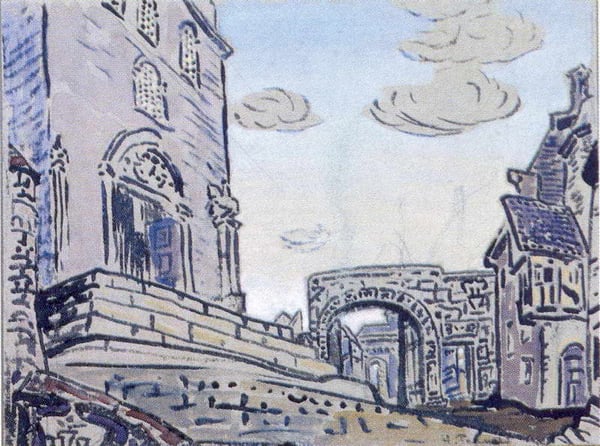
Analisi esperta di City di Nicholas Roerich
Stile: Art Nouveau (Modern) · Genere: cityscape
Expert Analysis of "City" by Nicholas Roerich
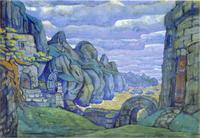
Nicholas Roerich’s City is a striking cityscape executed within the Art Nouveau (Modern) style, yet it transcends the movement’s typical ornamental concerns by imbuing the urban landscape with a profound spiritual and symbolic dimension. The work’s significance lies in how it reimagines the city not as a bustling, modern metropolis but as a timeless, almost otherworldly vision—a hallmark of Roerich’s broader philosophical and artistic quest.
Within the Art Nouveau Context
Art Nouveau is celebrated for its sinuous, organic lines, decorative elegance, and integration of nature and artifice. Roerich, however, subverts these expectations. City retains the movement’s flattened, patterned surfaces and rich, jewel-toned color harmonies typical of Art Nouveau painting, but its subject matter pushes beyond decorative urban views. Instead of depicting contemporary streets or architectural details, Roerich conjures a majestic, idealized cityscape—complete with soaring towers, fortress-like walls, and a dramatic atmospheric palette—that feels both ancient and futuristic. The lack of human figures or modern infrastructure (factories, trains) emphasizes a contemplative, almost sacred stillness.
Period Significance: Symbolism Meets Modernity
Roerich was deeply influenced by his Russian heritage, theosophy, and Eastern spiritual traditions. In City, these influences merge with Art Nouveau’s aesthetic to produce a work that stands as a visual manifesto for a “city of the future”—a harmonious, spiritual center rather than a site of industrial progress. The composition’s layered planes of color and simplified, almost abstract forms anticipate later modern developments while remaining rooted in Art Nouveau’s love for rhythmic pattern. The sky’s glowing, stratified bands and the architecture’s stylized silhouettes evoke a mystical atmosphere, aligning Roerich with Symbolist currents that often ran parallel to Art Nouveau.
Significance as a Cityscape
As a cityscape, City is remarkable for its refusal to document any real location. Roerich invented an archetypal city—a “Shambhala” or sacred citadel—that communicates his lifelong fascination with the unification of art, religion, and nature. This makes the work a precursor to later visionary urban utopias in 20th-century painting, while its decorative surface and planar space remain firmly within the Art Nouveau idiom. The painting thus occupies a unique crossroads: it is both a product of its stylistic moment and a radical departure into metaphysical terrain, securing Roerich’s reputation as a singular voice who used Art Nouveau not for decoration alone, but as a vessel for transcendent meaning.
Museum / Gallery
Visivamente simili
20 opere con composizione e palette affini
City
Nicholas Roerich
City
Nicholas Roerich
Kalmunz
Gabriele Munter
Sin título
Joy Hester
Das graue Haus
Varlin
Terem
Nicholas Roerich
Scenery sketch for Mussorgsky's opera "Khovanshchina"
Nicholas Roerich
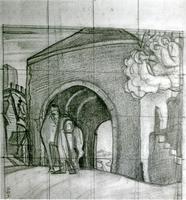
St. Mercurius of Smolensk
Nicholas Roerich
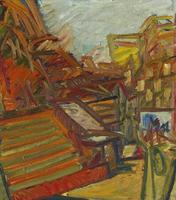
To the Studios
Frank Auerbach
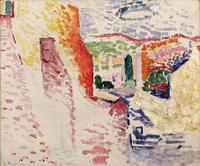
Sun Street
Henri Matisse
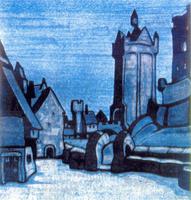
Street in front of castle
Nicholas Roerich
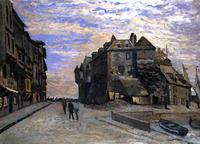
The Lieutenancy at Honfleur
Claude Monet
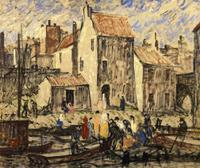
Boating Party
Robert Spencer
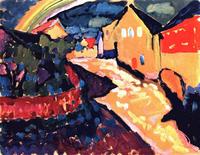
Murnau with rainbow
Wassily Kandinsky
Czóbel Béla Szentendre Részlet, Tus , Papír, 31x23.5cm
Bela Czobel
Methodist Chapel
Frances Hodgkins
Yaroslavna's Lament
Konstantin Korovin
Ydra
George Mavroides
Cagnes-sur-Mer
William H. Johnson
Tristan's castle in Brittany
Nicholas Roerich