
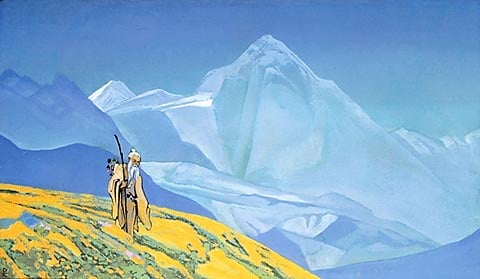
Nicholas Roerich sanatçısının Charaka eseri hakkında uzman analizi
Tarz: Symbolism · Tür: history painting
Expert Analysis of "Charaka" by Nicholas Roerich
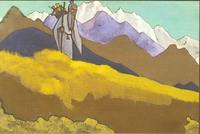
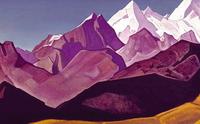
Nicholas Roerich’s "Charaka" stands as a seminal work within the Symbolist movement, distinguished by its fusion of historical reverence and transcendent spirituality. As a history painting, it transcends mere documentation, instead using symbolic language to elevate its subject—the ancient Indian physician and sage Charaka—into a universal archetype of wisdom and healing.
Significance within Symbolism and Roerich’s Oeuvre
Roerich, deeply influenced by Eastern philosophy and Theosophy, subverts traditional history painting by prioritizing inner meaning over narrative accuracy. In Charaka, the figure emerges not as a portrait of a specific individual, but as a timeless embodiment of knowledge. The artist’s hallmark use of luminous, otherworldly blues and golds—a palette drawn from his famed Himalayan series—imbues the scene with a meditative, ethereal quality. The composition is deliberately simplified: Charaka stands or sits in calm, hieratic stillness, his posture echoing that of a Bodhisattva, while the surrounding landscape (perhaps a mountain peak or an abstracted cosmic space) recedes into atmospheric tone. This reduction of detail aligns with Symbolist ideals, where emotional and spiritual resonance supersedes physical verisimilitude.
Symbolic Layers
Roerich invests every element with meaning. Charaka’s robe, likely saffron or white, suggests renunciation and purity. A subtle halo or radiating light around his head—a motif common in Roerich’s saints and teachers—signifies his enlightened status. The absence of dramatic action or anecdotal detail forces the viewer to contemplate the figure’s inner power: Charaka as a channel between cosmic truth and human suffering. The title itself, simply “Charaka,” evokes both the historical author of the Charaka Samhita (a foundational Ayurvedic text) and the Sanskrit root car (to move), linking wisdom to compassionate action.
Art-Historical Impact
This painting exemplifies Roerich’s departure from European historical painting conventions (e.g., Delacroix’s dramatic tableaux) and his creation of a new visual language for spiritual history. By placing a non-Western sage in a hieratic, icon-like format, Roerich challenges the Eurocentric canon and anticipates the global turn in modern art. Charaka thus functions as a bridge—between East and West, history and myth, materialism and mysticism—and remains a powerful testament to Symbolism’s capacity to invest historical subjects with enduring, universal truth.
Görsel olarak benzer
İlişkili kompozisyon ve renk paletine sahip 20 eser
Kuluta. Dobi Nulla.
Nicholas Roerich
Ienno-Guio-Dia - friend of travelers
Nicholas Roerich
Vyas Kund
Nicholas Roerich
Red Lama
Nicholas Roerich
Himalayas
Nicholas Roerich
Bell Mountain
Nicholas Roerich

Treasure of snows (Kangchenjunga)
Nicholas Roerich
Compassion
Nicholas Roerich
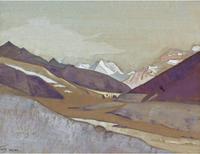
Shayok, the eighth day
Nicholas Roerich
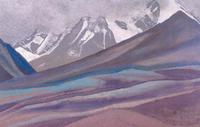
Pass
Nicholas Roerich

Himalayas. Blue mountains.
Nicholas Roerich

Himalayas. Pink peaks.
Nicholas Roerich
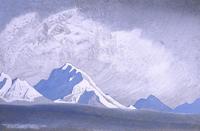
Himalayas
Nicholas Roerich
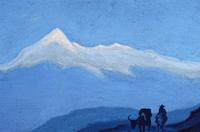
Lonely wanderer
Nicholas Roerich
Pearl of Searching
Nicholas Roerich
Charaka
Nicholas Roerich
Mountain Eagles (Tibetan stupa)
Nicholas Roerich
Tibet. Sacred stones. Mongolia.
Nicholas Roerich
Sacred Himalayas
Nicholas Roerich

Everest
Nicholas Roerich