
Analisi esperta di Mongolian horseman di Nicholas Roerich
Stile: Symbolism · Genere: genre painting
Expert Analysis of Mongolian Horseman by Nicholas Roerich
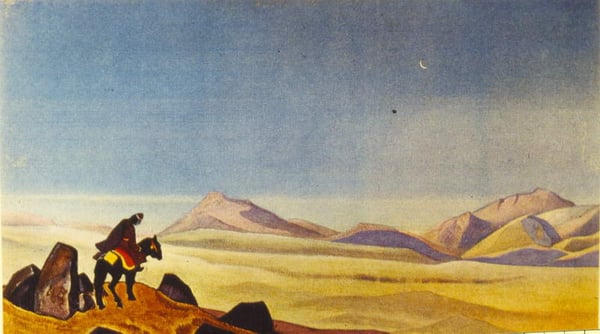
Within the Symbolist movement, Nicholas Roerich’s Mongolian Horseman stands as a masterful fusion of ethnographic observation and spiritual allegory, elevating a genre scene into a transcendent meditation on humanity’s connection to the ancient, untamed landscape. The work is significant for how it uses the conventions of genre painting—depiction of everyday nomadic life—not as mere documentation, but as a vehicle for Symbolist ideals: the search for inner truth, the resonance of myth, and the sublime power of nature.
Roerich, deeply influenced by his expeditions through Central Asia, transforms the solitary horseman into an archetypal figure. The rider does not simply cross the steppe; he becomes a timeless symbol of the journey between worlds—earth and sky, material and spiritual. The muted, earthy palette and simplified forms characteristic of Roerich’s style evoke the stark grandeur of Mongolia while stripping away anecdotal detail. This simplification forces the viewer to see the horseman not as a specific individual but as a universal presence, akin to the guardian figures in Roerich’s later Himalayan series.
Crucially, the work’s significance lies in its defiance of Western realism. Where a naturalist painter might emphasize anatomical accuracy or local costume, Roerich subordinates such details to mood and symbolism. The horseman appears almost as a hieroglyph—a shape that echoes the surrounding mountains and sky, suggesting the human form is inseparable from the landscape itself. This reflects the Symbolist belief that art should evoke, not merely depict, and that the external world is a veil for deeper spiritual realities.
As a genre painting, Mongolian Horseman thus expands the category’s possibilities. It is not a simple slice of life but a portal: the horseman’s journey mirrors the soul’s pilgrimage. In the context of Roerich’s oeuvre and Symbolism at large, this work exemplifies how a seemingly everyday motif can become a vessel for cosmic significance, bridging the particular traditions of Mongolia with the universal language of myth.
Visivamente simili
20 opere con composizione e palette affini
Genghis Khan
Nicholas Roerich

Marvelous miracle (To the feat)
Nicholas Roerich
Mother of Genghis Khan
Nicholas Roerich
Oirot Messenger of the White Burkhant
Nicholas Roerich
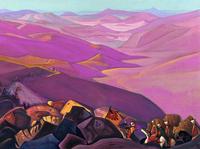
Mongolia (Campaign of Genghis Khan)
Nicholas Roerich
Charaka
Nicholas Roerich

Voice of Mongolia
Nicholas Roerich
Chenrezig
Nicholas Roerich

Order of Rigden Jyepo
Nicholas Roerich
Remember
Nicholas Roerich
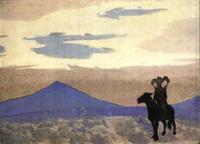
Mother of Genghis Khan
Nicholas Roerich
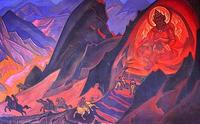
Order of Rigden Jyepo
Nicholas Roerich
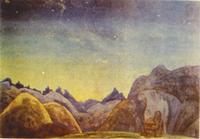
Starry sky
Nicholas Roerich

Human ancestors
Nicholas Roerich
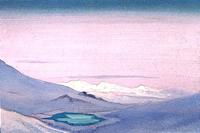
Himalayas
Nicholas Roerich
Soria Moria Slott
Theodor Severin Kittelsen

Kangchenjunga
Nicholas Roerich
He who hastens
Nicholas Roerich

Lake of Gennesaret
Nicholas Roerich
Mongolia. Yurtas.
Nicholas Roerich