
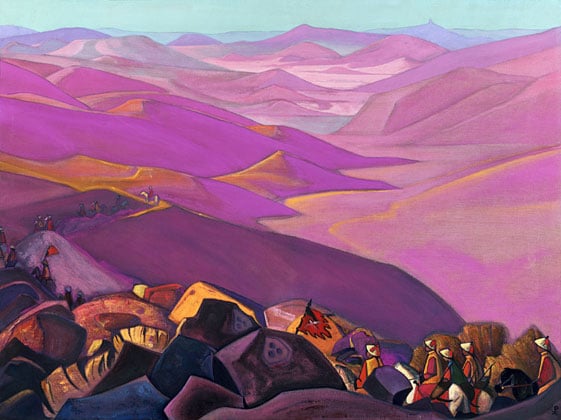
Nicholas Roerich sanatçısının Mongolia (Campaign of Genghis Khan) eseri hakkında uzman analizi
Tarz: Symbolism · Tür: history painting
Expert Analysis: "Mongolia (Campaign of Genghis Khan)" by Nicholas Roerich
Nicholas Roerich’s Mongolia (Campaign of Genghis Khan) stands as a compelling intersection of historical narrative and Symbolist vision, marking the artist’s unique contribution to early 20th-century painting. As a work of Symbolism executed within the genre of history painting, it transcends mere documentation of a military conquest to become a meditation on spiritual destiny, cultural power, and the sublime forces of nature.
Stylistic Significance within Symbolism
Roerich, a leading figure in Russian Symbolism, rejected realistic representation in favor of evocative, mystical imagery. In this painting, he employs a highly distinctive palette—often characterized by deep blues, purples, and golds—to imbue the Mongolian landscape with an otherworldly, almost cosmic atmosphere. The composition likely emphasizes the interplay between human ambition and the vast, untamed environment, a hallmark of Roerich’s work. Mountains, skies, and plateaus are not mere backdrops but active participants in the narrative, symbolizing the eternal tension between civilization and nature, the material and the spiritual. This aligns with the Symbolist goal of suggesting hidden truths and inner experience rather than depicting outward appearances.
Genre and Historical Interpretation
As a history painting, Mongolia (Campaign of Genghis Khan) does not aim for archaeological accuracy. Instead, it reimagines the Mongol campaigns—and Genghis Khan himself—as archetypal forces of transformation. Roerich was deeply fascinated by the spiritual cultures of Central Asia and the East, viewing the Mongol empire not as a story of destruction but as a catalyst for cultural exchange and spiritual awakening. The painting thus fuses historical subject matter with Symbolist allegory: the marching hordes become a metaphor for the inexorable march of destiny, while the luminous landscape suggests a transcendent purpose beyond conquest.
Significance within Roerich’s Oeuvre and the Broader Movement
This work is significant for several reasons:
- Cultural Synthesis: Roerich was a pioneer in bridging Western Symbolism with Eastern philosophical and aesthetic traditions, particularly those of Tibet, Mongolia, and India. Mongolia (Campaign of Genghis Khan) exemplifies his lifelong quest to portray the unity of human spiritual evolution across cultures.
- Mystical Nationalism: Created during a period of rising interest in Eurasianism and Russia’s historical ties to the steppe, the painting resonates with Roerich’s belief that the true soul of Russia lay in its connection to the ancient nomadic civilizations of the East.
- Visual Language: Roerich’s use of flattened planes, rhythmic lines, and jewel-like color creates a decorative, almost icon-like quality that elevates the scene from historical illustration to ritualistic vision. This approach was influential for later Symbolist and metaphysical painters.
In summary, Mongolia (Campaign of Genghis Khan) is a masterful synthesis of history and symbolism, where the epic march of Genghis Khan’s army becomes a timeless allegory for spiritual quest, cosmic harmony, and the cyclical power of nature. It demonstrates Roerich’s belief that art should reveal the hidden forces of the world, making this painting a key example of Symbolism’s capacity to transform historical narrative into metaphysical revelation.
Museum / Gallery
Görsel olarak benzer
İlişkili kompozisyon ve renk paletine sahip 20 eser
Desert
Martiros Sarian
Notable day in the mountains
Martiros Sarian
Mongolian horseman
Nicholas Roerich
Mother of Genghis Khan
Nicholas Roerich
Mongolia. Yurtas.
Nicholas Roerich
Genghis Khan
Nicholas Roerich

Voice of Mongolia
Nicholas Roerich
Order of Rigden Jyepo
Nicholas Roerich
Indigenous Gathering
Jacqueline Hick
He who hastens
Nicholas Roerich
Marvelous miracle (To the feat)
Nicholas Roerich
The Camel Ride
Konstantin Gorbatov
Bizani
Thalia Flora-Karavia
The Flight into Egypt
Jean-Leon Gerome
Landscape.Illustration to the poem by Shota Rustaveli 'The Knight in the Panther's Skin'
Hryhorii Havrylenko
A depiction of the Cintamani being carried by the Lung Ta (Wind Horse)
Nicholas Roerich
The Arab and his Steed
Jean-Leon Gerome
Ladakh
Nicholas Roerich
Mohammed the Prophet
Nicholas Roerich
Mountain landscape
Martiros Sarian