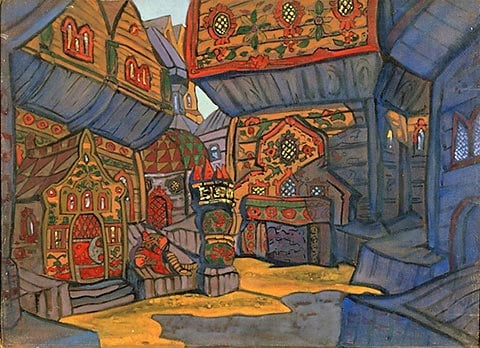
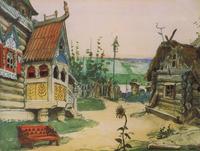
The court of Prince Vladimir Galitsky (Study of scene design for "Prince Igor")
Dettagli
Analisi esperta di The court of Prince Vladimir Galitsky (Study of scene design for "Prince Igor") di Nicholas Roerich
Stile: Art Nouveau (Modern) · Genere: design
As an expert art historian, I will analyze "The court of Prince Vladimir Galitsky (Study of scene design for 'Prince Igor')" by Nicholas Roerich, using only the provided facts.
Analysis:
This work is a study for a scene design created for Alexander Borodin's opera Prince Igor. Its significance lies in how it exemplifies the distinctive fusion of Russian medievalism with the decorative aesthetics of the international Art Nouveau (Modern) style.
Roerich, a pivotal figure in Russian Art Nouveau, uses the genre of design—specifically theatrical stage design—to merge historical research with modern visual language. While Art Nouveau is typically associated with organic, flowing lines and motifs from nature, Roerich adapts these principles to depict the ancient Russian court. The composition likely employs flattened space and a decorative, patterned approach that characterizes the style, but the content is distinctly Slavic and historical.
The study's significance is threefold:
- Cultural Synthesis: It represents a key moment in the development of Russian Art Nouveau, where national identity (medieval Russian history and folklore) was channeled through a modern, pan-European style. Roerich was a leading force in this "Russian Style" within Art Nouveau, and his work for Prince Igor is a landmark example.
- Theatrical Innovation: As a scene design study, it highlights Roerich's revolutionary approach to opera and ballet design. He did not just create a backdrop; he conceived an integrated visual environment that enhanced the narrative and music, using color and historical detail to evoke a specific atmosphere. His designs for Prince Igor are celebrated for their archaeological authenticity and powerful, painterly vision.
- Symbolic Use of Color and Form: True to the Art Nouveau fascination with symbolism, Roerich's palette—often employing vivid, almost luminous colors—and his treatment of architecture and costume imbue the scene with a sense of ancient, mythic grandeur. The court of the dissolute Prince Vladimir Galitsky is rendered not as a mere historical reconstruction, but as a visually striking, symbolic tableau that reflects the opera's themes of power, chaos, and Russian heritage.
In summary, this artwork is significant because it stands at the intersection of theatrical design, national romanticism, and the international Art Nouveau movement, showcasing Roerich's unique ability to create a modern, stylized vision of Russia's epic past.
Visivamente simili
20 opere con composizione e palette affini
The court of Prince Vladimir Galitsky (Study of scene design for "Prince Igor")
Nicholas Roerich
The court of Prince Vladimir Galitsky (Study of scene design for "Prince Igor")
Nicholas Roerich
Three pleasures
Nicholas Roerich
Tmutarakan
Nicholas Roerich
Berendei Palace
Viktor Vasnetsov
Terem
Nicholas Roerich
Nina Slobodka Berendeevka
Viktor Vasnetsov
Issuance of head
Nicholas Roerich
Berendeevka
Boris Kustodiev
Terem of Kikimora
Nicholas Roerich
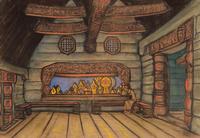
Tower chamber of Yaroslavna
Nicholas Roerich
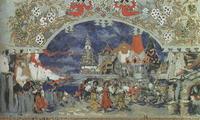
Trading Pier in the Capital City.Sketch of set for C. Pugni`s ballet
Konstantin Korovin
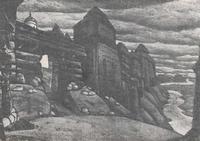
City wall
Nicholas Roerich
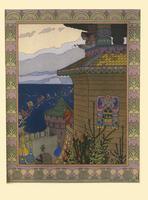
Illustration for the Russian Fairy Story "White duck"
Ivan Bilibin
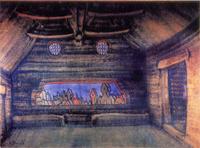
Terem of Yaroslavna. New moon.
Nicholas Roerich
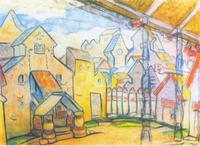
The court of Prince Vladimir Galitsky (Study of scene design for "Prince Igor")
Nicholas Roerich
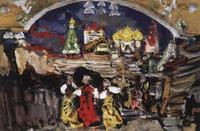
On the Square
Konstantin Korovin
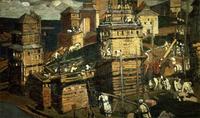
Building a City
Nicholas Roerich
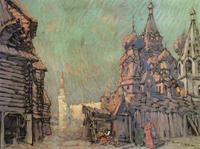
Red Square in Moscow
Konstantin Korovin
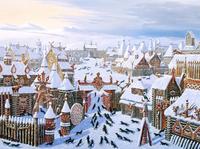
An Aria: The Departure of the Rus... The Return of the Wolves
Vsevolod Borisovich Ivanov