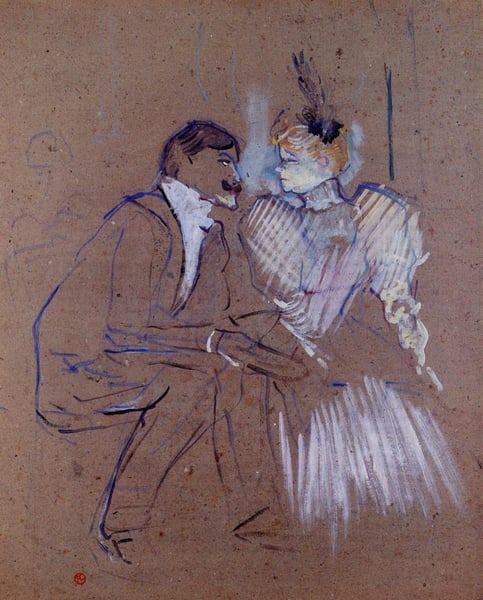
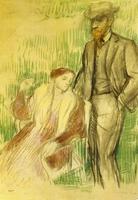
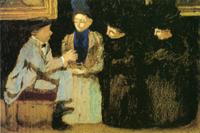
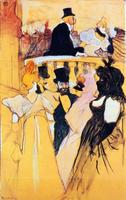
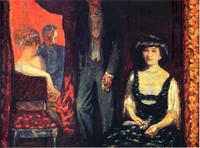
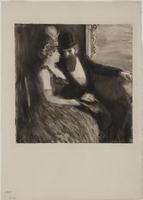
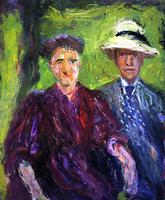
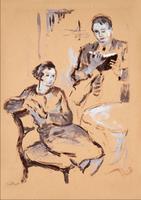
Henri de Toulouse-Lautrec’s Lucien Guitry and Granne Granier is a quintessential example of Post-Impressionist genre painting, notable for its vivid encapsulation of Parisian nightlife and the artist’s distinctive approach to portraiture. The work’s significance lies in how Toulouse-Lautrec employs bold, flat areas of color and expressive, almost caricatural linework—hallmarks of his Post-Impressionist style—to distill the personalities of two celebrated performers of the era. By choosing an unglamorous, behind-the-scenes moment (likely backstage or in a cabaret setting), he elevates everyday theatrical life into a compelling study of character and social milieu. This piece exemplifies the artist’s ability to merge commercial poster art’s immediacy with fine art’s psychological depth, a fusion that defined his contribution to the movement. The cropping and asymmetrical composition, influenced by Japanese woodblock prints, further underscore the spontaneity of the scene, making it a vivid document of Belle Époque entertainment and a key work in understanding how Post-Impressionists used genre scenes to explore modern urban experience.