Description
Style: Baroque · Genre: portrait, tronie
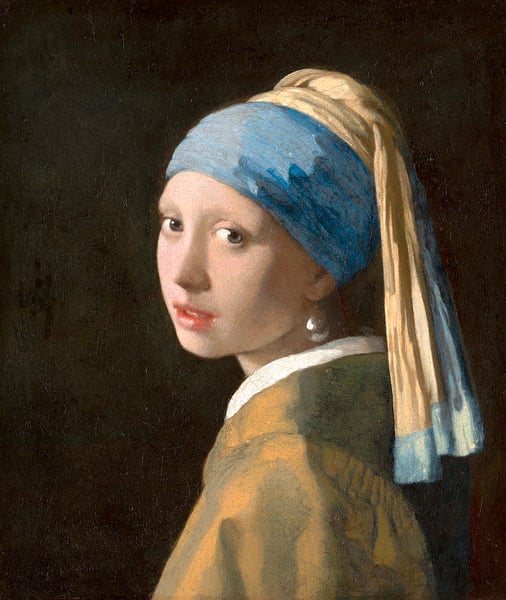
The Girl with a Pearl Earring, Jan Vermeer’s most famous painting, is often called the ‘Dutch Mona Lisa’. The comparison to Leonardo Da Vinci’s Mona Lisa (ca. 1504) makes sense: both paintings share an air of mystery, from the model’s enigmatic gaze to the speculations surrounding the identities of the women in the paintings. The identity of the model in The Girl with a Pearl Earring remains unknown. Some have suggested that it is Vermeer’s eldest daughter, Maria, however there is no compelling evidence to confirm this assertion.
The painting is considered a tronie, a subcategory of portraiture that was popular in the Dutch Golden Age and Flemish Baroque art. Tronies are studies of facial characteristics, stereotypical characters or exaggerated expressions. Vermeer captures a fleeting moment, the girl turning her head, her lips slightly parted while she directly faces the viewer. The girl wears a head wrap inspired by a Turkish turban and an enormous pearl earring. These exotic elements increase the drama of the painting, and give the artist the opportunity to display artistic effects in his treatment of light and texture. Another tronie by Vermeer, Study of A Young Woman (ca. 1665-1667) is often seen as a variant or counterpart of The Girl with a Pearl Earring. In both paintings, the figures are set against a black background, wearing the pearl earring and having a scarf draped over the shoulder. While The Girl with a Pearl Earring is an idealized beauty, the Study of A Young Woman shows plain and imperfect facial features.
Even though The Girl with a Pearl Earring is consistent with Vermeer’s style and technique, it is distinct in a few noteworthy ways. Vermeer used his inventive method of layering paint that created the sensuality of the soft skin. This was accomplished by layering a thin flesh-colored glaze over a transparent under-modelling (the initial layers of color placed on the surface). Some have suggested that Vermeer was able to capture these details and effects through the use of camera obscura, an optical device that was able to project an image onto a flat surface. Vermeer employed this technique in other paintings, like Woman Holding a Balance (1665) and Young Woman with a Water Pitcher (ca. 1662-1665). In both cases, Vermeer used this technique of layering paint when creating the shaded portions of the headdress on the models. However, in The Girl with a Pearl Earring, the application of paint is bolder and more expressive. In a 1994 restoration, it was discovered that Vermeer accentuated girl’s mouth with small dots of pink paint, and placed light accents in her eyes to brighten her face. The model is set against a dark background, which is very different than the detailed settings of Vermeer’s interior paintings, such as the mentioned Woman Holding a Balance and Young Woman with a Water Pitcher. In the interior settings, the women are portrayed in contemplative and quiet moments, while The Girl with a Pearl Earring has a sense of immediacy and drama. The painting has a timeless quality, the girl bears no symbolic attributes, and she is not placed in any specific context. For this reason, she has captured the imagination of viewers throughout generations.
Museum / Gallery
Visually similar
20 works with related composition and palette
Moça com brinco de pérola
Lilian Greisse
Brave new world
Pirachi
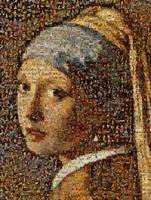
Girl with the Pearl Earring
Robert Silvers
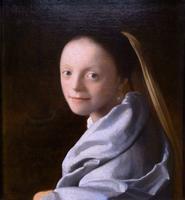
Study of a young woman
Johannes Vermeer
Portrait of an Italian Woman
Wenzel Tornøe
Parasztlány
Bela Czobel
Head of a peasant woman
Michele Cammarano
Portrait of a young women
Wilhelm Menzler
Jeanne Calvet
Jules Breton
Girl with Accordion
Alexey Venetsianov
Italian three-quarter
Anton Romako
The Red Scarf
Nicolae Vermont
Bauernmädchen mit weißem Kopftuch
Wilhelm Leibl
Study for Disappointed Love
Karl Ferdinand Sohn
Portrait of a girl
Henry Mosler
Magus
John Currin
Head of a Young Farmer
Nicolae Grigorescu
Study of a Young Girl in a Turban and Frilled Collar
Joseph Wright
Portrait of a Peasant Girl
Ion Andreescu
Oriental woman
Jean-François Portaels