Analisi esperta di Portrait of Naniwaya Okita di Kitagawa Utamaro
Stile: Ukiyo-e · Genere: portrait
Expert Analysis: Portrait of Naniwaya Okita by Kitagawa Utamaro (Ukiyo-e, Portrait Genre)
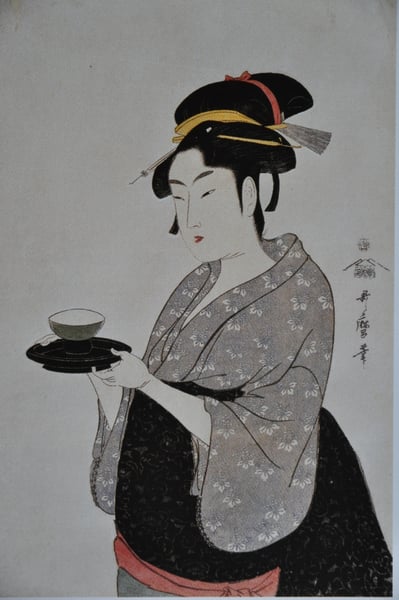
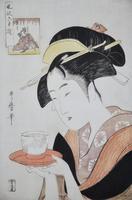
Utamaro’s Portrait of Naniwaya Okita stands as a hallmark of late-18th-century Ukiyo-e, celebrated for its intimate, psychological depth and technical refinement. Executed in the ōkubi-e (“big head”) style—a format Utamaro himself pioneered—the work departs from conventional full-length depictions of courtesans and tea-house beauties. Instead, it focuses on Okita’s expressive face, delicate features, and subtle gesture, bringing the viewer into a private, almost candid moment.
The significance of this portrait lies in how Utamaro elevates a working woman—Naniwaya Okita was a renowned waitress at a Tokyo tea house—into a subject of refined artistry. He captures not merely her physical beauty but a sense of individuality and quiet poise, a radical shift from the more standardized, idealized beauties of earlier Ukiyo-e. The composition is spare: Okita’s head turns slightly, one hand partially raising a small object to her lips (likely a tenugui towel or a cup), while the background is left largely blank. This minimalism forces attention on the exquisite linework—the flowing kakemono-e brushstrokes of her hair, the soft, graded colors of her kimono’s collar, and the faint blush on her cheeks.
Utamaro’s mastery of kabuki-mono printing techniques (such as karazuri blind embossing for textile patterns and bōkashi gradation for depth) gives the portrait a sculptural, three-dimensional quality unusual for woodblock prints. More than a simple likeness, Portrait of Naniwaya Okita exemplifies the Ukiyo-e artist’s ability to blend commercial portraiture with high artistic sensitivity, influencing later European artists like Degas and Mary Cassatt. It remains a touchstone for the genre, demonstrating how Ukiyo-e could capture the fleeting elegance of everyday life while granting its subject an enduring, iconic dignity.
Visivamente simili
20 opere con composizione e palette affini
The geisha kamekichi
Kitagawa Utamaro
Woman in bedroom on rainy night
Kitagawa Utamaro
Looking thirsty - The Appearance of a Town Geisha, a Bargirl in the Ansei Era
Tsukioka Yoshitoshi
The Hour of the Oxx
Kitagawa Utamaro
Girl blowing Vidro
Kitagawa Utamaro
Bijin
Keisai Eisen
Portrait of Naniwaya Okita
Kitagawa Utamaro
Hour of the Snake
Kitagawa Utamaro
Middle Class Mother and Daughter
Kitagawa Utamaro
Looking eager to meet someone - The appearance of a courtesan of the Kaei period
Tsukioka Yoshitoshi
The Hour of the Tiger
Kitagawa Utamaro
Woman playing a poppin
Kitagawa Utamaro
Iwai Hanshirō IV as the wet nurse Shigenoi
Tōshūsai Sharaku
Bijin holding a flower pot
Toyohara Chikanobu
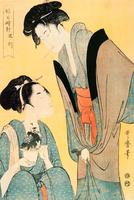
The Hour of the Hare
Kitagawa Utamaro
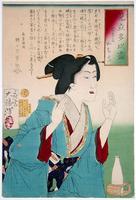
Desire
Tsukioka Yoshitoshi
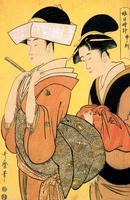
The Hour of the Ramin
Kitagawa Utamaro
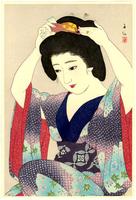
Maiko Preparing Coiffure
Natori Shunsen
Three Beauties of the Present Day
Kitagawa Utamaro
True Beauties
Toyohara Chikanobu