Secret love
Expert analysis of Kitagawa Utamaro’s Secret love
Style: Ukiyo-e · Genre: portrait
Expert Analysis of "Secret Love" by Kitagawa Utamaro
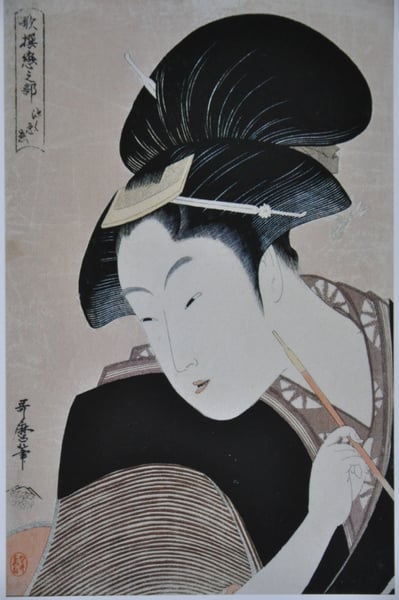
Kitagawa Utamaro’s “Secret Love” (c. 1790s) is a masterful example of bijin-ga (pictures of beautiful women) within the Ukiyo-e tradition. As a portrait, it transcends mere likeness to capture a moment of private emotional intensity—a hallmark of Utamaro’s genius.
Significance within Ukiyo-e and Utamaro’s Oeuvre
Utamaro revolutionized the portrayal of women in Ukiyo-e by shifting focus from idealized courtesans in flamboyant public settings to intimate, psychological studies. “Secret Love” exemplifies this shift. The work likely depicts a woman from the Yoshiwara pleasure district, but Utamaro strips away overt narrative context, concentrating instead on a fleeting, clandestine emotion—perhaps a stolen glance, a hidden note, or a suppressed smile. This emphasis on unspoken feeling was groundbreaking; few artists of the period dared to explore such subtle interiority.
Stylistic Hallmarks
Utamaro’s signature ōkubi-e (large-head pictures) format is not used here—instead, the composition is likely a half-length or bust portrait, allowing for nuanced detail in the woman’s expression and posture. The linework is supple and expressive: fine, flowing contours define the hair, the fall of the kimono, and the slight turn of the head, while the face is rendered with minimal strokes—an economy that forces the viewer to read the emotion in the eyes and mouth.
The title “Secret Love” suggests a narrative of concealed desire, a theme Utamaro explored frequently. The woman’s gaze is not directed at the viewer but averts, hinting at a private world. Her lips may be slightly parted, her hands perhaps tucked into her sleeve or holding a letter—common Utamaro motifs for longing or secrecy. The color palette is restrained but rich, typical of his mature work: subtle gradations of gray and muted reds, with perhaps a touch of green or blue in the obi, all printed from key-block outlines and delicate woodblock gradations (bokashi).
Cultural and Historical Importance
In Ukiyo-e, portraits often served as advertisements or records of famous beauties. Utamaro, however, elevated the genre to a study of universal human emotion. “Secret Love” reflects the ukiyo (“floating world”) ethos of fleeting pleasure and transient beauty, but it also hints at the melancholy underlying such passions. This work influenced later artists like Hokusai and even Western Impressionists, who admired Utamaro’s ability to evoke mood through line and gesture.
Ultimately, “Secret Love” is significant because it shows Utamaro at his most psychologically incisive: a portrait not just of a woman, but of a moment of hidden vulnerability—a quiet revolution in the history of Japanese printmaking.
Visually similar
20 works with related composition and palette
Portrait of Naniwaya Okita
Kitagawa Utamaro
Large Head and Bust Portrait of Beauty
Kitagawa Utamaro
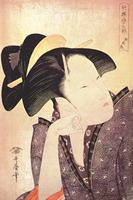
Pensive love
Kitagawa Utamaro
Kabuki Actor Nakayama Tomisaburō I as Ohisa, Wife of Sazanami Tatsugorō, Actually Teriha, the Younger Sister of Sadatō (aiban)
Tōshūsai Sharaku
Iwai Hanshirō IV as San, the maid servant of Ukiyonosuke, actually Saeda, the younger sister of Sabanosuke
Tōshūsai Sharaku
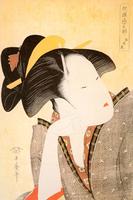
Geisha
Kitagawa Utamaro
Kabuki Actor Osagawa Tsuneyo II, Possibly in the Rôle of Ippei's Sister Osan
Tōshūsai Sharaku
Segawa Tomisaburō as Yadorigi, Wife of Ogishi Kurando, by Tōshūsai Sharaku
Tōshūsai Sharaku
The geisha kamekichi
Kitagawa Utamaro
Woman with a Mirror
Kitagawa Utamaro
Ichikawa Shocho II as Oman
Yamamura Toyonari
Kikunojō Segawa III as Nakai Ohama in Hana No Miyako Kuruwa No Nawabari
Tōshūsai Sharaku
Iwai Hanshirō IV as the wet nurse Shigenoi
Tōshūsai Sharaku
Iwai Hanshirō IV as Shigenoi in the Play "Koinyōbō Somewake Tazuna"
Tōshūsai Sharaku
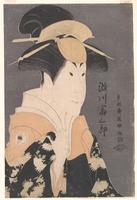
Segawa Tomisaburō II as Yadorigi in the Play "Hana Ayame Bunroku Soga"
Tōshūsai Sharaku
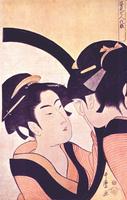
Beauty at toilet
Kitagawa Utamaro
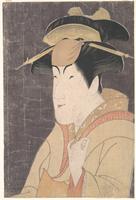
Nakayama Tomisaburō as Miyagino in the Play "Katakiuchi Noriyaibanashi"
Tōshūsai Sharaku
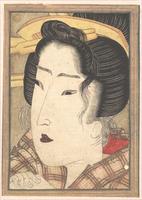
Head of a Beauty
Keisai Eisen
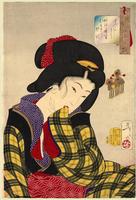
Looking shy - The appearance of a young girl of the Meiji era
Tsukioka Yoshitoshi
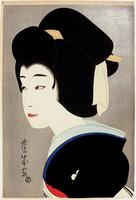
Sawamura Sonosuke I as Umegawa
Yamamura Toyonari