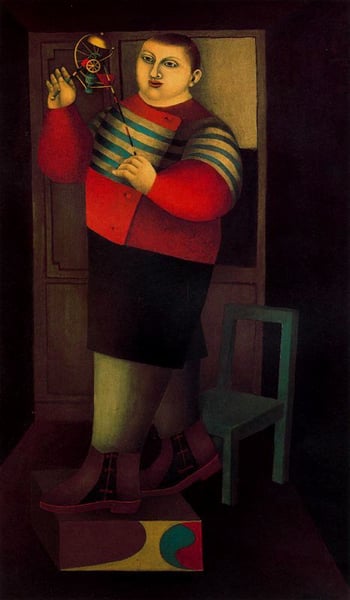
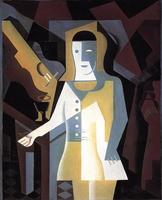
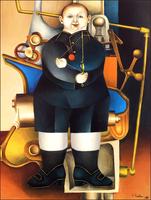
In Richard Lindner's "Boy with machine", the artist synthesizes the fragmented geometry of Cubism with the cold, industrial precision of mechanical forms, creating a portrait that is both human and dehumanized. This fusion—termed Mechanistic Cubism—elevates the work beyond a simple likeness; it becomes a commentary on the modern individual’s integration with, or subjugation by, technology. The "boy" is rendered not through organic curves but through angular, machine-like components, suggesting that identity in the 20th century is itself assembled from interchangeable, industrial parts. The significance lies in this radical redefinition of portraiture: instead of capturing a soul, Lindner captures a functional, almost robotic archetype, reflecting the anxieties and aesthetics of an age of mechanization.