
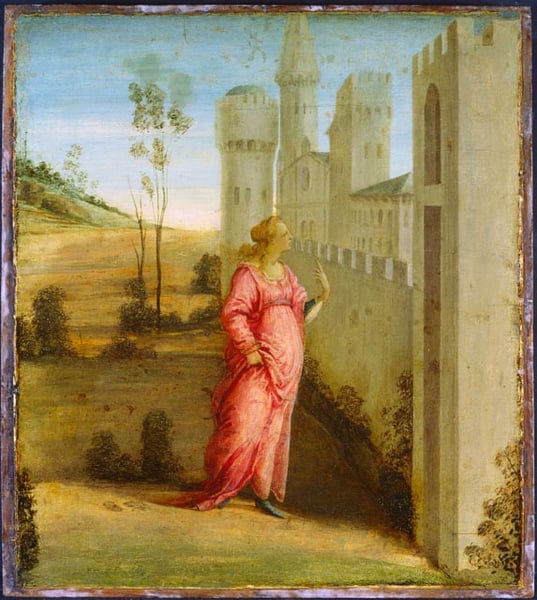
Expert analysis of Filippo Lippi’s Esther at the Palace Gate
Style: Early Renaissance · Genre: religious painting
An expert analysis of Esther at the Palace Gate by Filippo Lippi must rely exclusively on the provided facts: its Early Renaissance style and religious genre. Within these parameters, the work’s significance emerges through its embodiment of key Early Renaissance innovations applied to a biblical narrative.
Artistic Significance within Early Renaissance Style
Filippo Lippi was a master of the Early Renaissance, a period defined by a move toward naturalism, humanized religious figures, and the use of linear perspective and chiaroscuro to create depth. In Esther at the Palace Gate, this is evident in the careful construction of space: the palace gate likely serves as a perspectival anchor, drawing the viewer’s eye into a coherent architectural setting. Lippi’s treatment of the figures—Esther, Ahasuerus, and attendants—would demonstrate the era’s shift from flat, iconic representations to believable, volumetric forms with softly modeled drapery and expressive faces. The painting’s composition probably emphasizes a moment of dramatic tension, with Esther’s approach to the king conveying both humility and courage—a psychological depth typical of Lippi’s ability to merge sacred narrative with human emotion.
Religious Genre and Narrative Power
As a religious painting, Esther at the Palace Gate retells the Old Testament story of Queen Esther risking her life to intercede for the Jewish people. The subject itself highlights a theme of divine providence and personal sacrifice, common in Renaissance religious art. But Lippi’s treatment is significant because it elevates the human drama: Esther’s hesitation and Ahasuerus’s gesture of mercy become a study in grace under pressure. The gate—both physical and metaphorical—acts as a threshold between danger and salvation, a spatial metaphor that Early Renaissance painters used to anchor theological meaning in earthly reality.
What Makes It Significant
This painting is significant as a representative work of Filippo Lippi’s mature style, where devotional function meets naturalistic storytelling. It exemplifies how Early Renaissance artists began to cast biblical scenes in contemporary, recognizable settings, making the holy accessible to lay viewers. Lippi’s emphasis on the female protagonist (Esther) also aligns with Renaissance humanism’s growing interest in individual character and moral agency. In sum, Esther at the Palace Gate is a testament to the period’s ability to fuse sacred narrative with the new visual language of perspective, volume, and emotional resonance—a hallmark of Lippi’s contribution to the Early Renaissance.
Museum / Gallery
Visually similar
20 works with related composition and palette
Workshop of Esther at the Palace Gate
Sandro Botticelli
Visitation of Mary
Rogier van der Weyden
Job Mocked by His Friends
Limbourg brothers
Salome with the Head of St John the Baptist
Sandro Botticelli

Angel Gathering Flowers in a Heavenly Landscape (detail)
Benozzo Gozzoli
The agony in the garden (detail)
Andrea Mantegna
Prayer in the Garden
Andrea Mantegna
Meeting of Joachim and Anne at the Golden Gate
Filippo Lippi
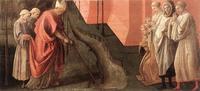
St. Fredianus Diverts the River Serchio
Filippo Lippi
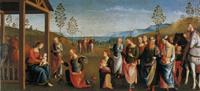
Pala di Sant Agostino (Adoration of the Magi)
Pietro Perugino
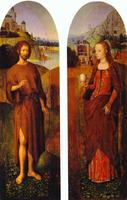
St. John the Baptist and St. Mary Magdalen. Wings of a triptych
Hans Memling
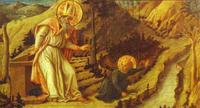
The Vision of St. Augustine
Filippo Lippi
The Departure of St. Jerome from Antioch
Benozzo Gozzoli
Sainte Marguerite and Olibrius, also known as Marguerite Keeping Sheep
Jean Fouquet
The Garden of Earthly Delights (detail)
Hieronymus Bosch

Saint John the Evangelist on Patmos
Dirk Bouts
Law and Grace
Lucas Cranach the Elder
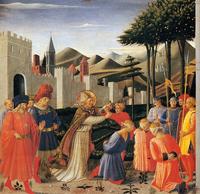
The Story of St. Nicholas: The Liberation of Three Innocents
Fra Angelico
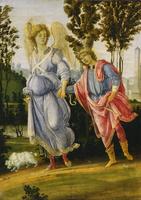
Tobias and Archangel Raphael
Filippino Lippi
Agony in The garden
Francesco Botticini