Viktor Vasnetsov の The princess at the window (Princess Nesmeyana) の専門的な分析
スタイル:Romanticism · ジャンル:mythological painting
Expert Analysis: "The Princess at the Window (Princess Nesmeyana)" by Viktor Vasnetsov
Viktor Vasnetsov’s The Princess at the Window (Princess Nesmeyana) is a quintessential example of Romanticism applied to Russian mythological subjects. The painting derives its significance from Vasnetsov’s masterful synthesis of folkloric narrative, emotional introspection, and the Romantic ideal of national identity.
Context and Subject
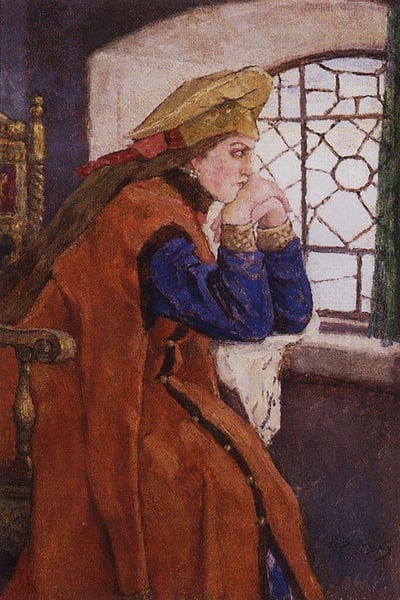
The work depicts Princess Nesmeyana, a figure from Russian fairy tales known for her perpetual sorrow—the “un-smiling” princess who cannot laugh despite her riches. Vasnetsov transforms this folk motif into a poignant study of isolation and longing. The princess is shown at a high, narrow window, her gaze distant and melancholic, framed by the ornate architecture of a traditional terem (a medieval Russian tower chamber). This setting, rich in decorative patterns and subdued colors, evokes the enclosed world of a royal woman bound by duty and tradition.
Stylistic Significance
Within the Romantic movement, Vasnetsov prioritizes emotional depth and the sublime mystery of the natural and supernatural. The painting’s significance lies in its use of:
- Symbolic architecture: The window acts as a threshold between the confined, gilded space of the court and the unknown outside—a metaphor for the princess’s unfulfilled desires. The heavy stone frame and intricate carvings emphasize her entrapment.
- Atmospheric lighting: A soft, diffused light falls on the princess’s face, highlighting her pale skin and wistful expression, while the interior remains in shadow. This chiaroscuro technique heightens the sense of quiet tragedy.
- Mythological realism: Vasnetsov merges precise historical details (costume, ornament) with an idealized, archetypal figure. The princess is not a specific portrait but an embodiment of a collective cultural memory, making the work a bridge between Romantic individualism and national myth.
Contribution to Russian Art
Vasnetsov was a pioneer in elevating Russian folklore to the level of high art, aligning with Romanticism’s embrace of the folk as a source of authentic spirit. The Princess at the Window exemplifies his ability to infuse a traditional tale with psychological complexity—the princess’s silent suffering reflects the broader Romantic fascination with the unattainable and the melancholy soul. The painting thus holds its significance as both a visual fairy tale and a profound commentary on solitude, duty, and the yearning for freedom.
視覚的に類似
構図やパレットが近い作品 20 件
Romeo and Juliet
Konstantin Makovsky

The soothsayer
Rupert Bunny
Giotto Painting the Portrait of Dante
Dante Gabriel Rossetti
Go make her beauty vary day by day
Eleanor Fortescue-Brickdale
The model in the ancient russian costume
Vasily Surikov
Claudio and Isabella
William Holman Hunt
Waiting
Sergey Solomko
The lesson
Silvestro Lega
Portrait of Marie Lagadu
Paul Serusier
Hunding discovers the likeness between Siegmund and Sieglinde
Arthur Rackham
The lady Lyoness had the dwarf in examination
N.C. Wyeth
Menshikov in Berezovo
Vasily Surikov
Amsterdam orphan girl seated at the window
Nicolaas van der Waay
Servant of Cardinal
Fyodor Bronnikov
Portrait de la tante Octavie
Maximilien Luce
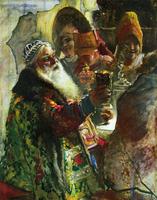
Portrait of Prince P.Vyazemsky
Konstantin Makovsky
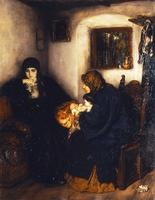
After the memorial service
Nikolaos Gyzis
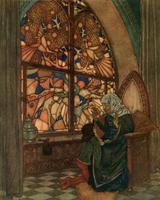
His grandmother had Told Him (from The Garden of Paradise)
Edmund Dulac
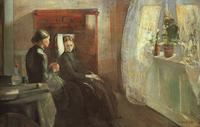
Spring
Edvard Munch
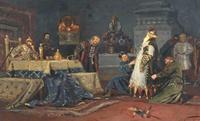
Clownish coat. Boyar Morozov A. in front of Ivan the Terrible
Mikhail Nesterov