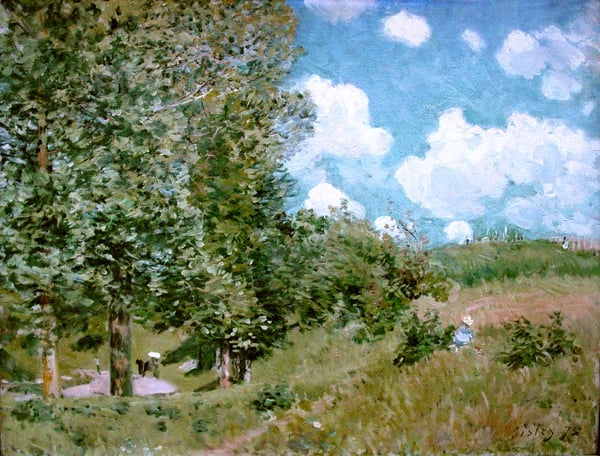
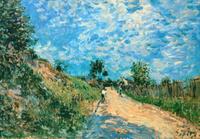
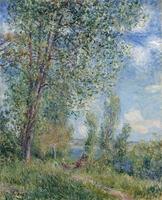
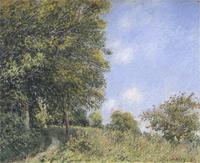
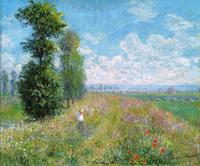
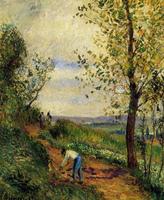
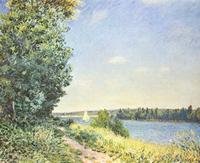
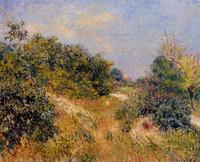
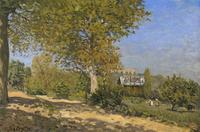
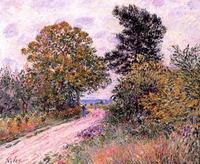
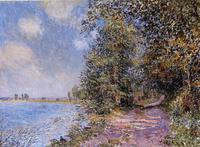
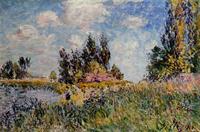
As a work of Impressionism, Alfred Sisley's "Road from Versailles to Saint Germain" exemplifies the movement’s core commitment to capturing transient atmospheric effects and the interplay of light on the natural landscape. Sisley, a dedicated plein-air painter, distinguishes himself within the movement for his consistent focus on landscape as a pure, almost lyrical subject—eschewing the narrative or social commentary found in works by some of his contemporaries. The significance of this painting lies in its delicate balance of structure and spontaneity: the road receding into the distance provides a clear compositional anchor (a hallmark of Sisley’s orderly naturalism), while the loose, broken brushwork and subtle shifts in color convey the fleeting quality of weather and time of day. Unlike more aggressive Impressionist innovations, Sisley’s approach here is restrained and poetic, emphasizing harmony and the quiet beauty of an ordinary road transformed by light. This work thus represents a quintessential example of Impressionist landscape art, wherein the artist’s primary concern is not the site itself but the moment of perception.