
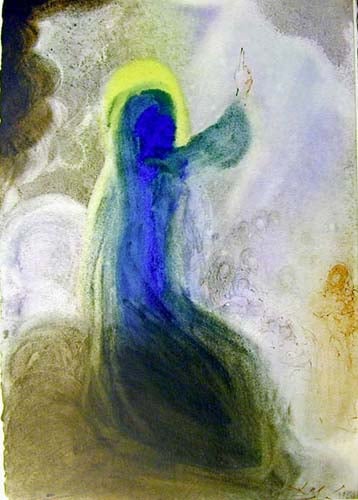
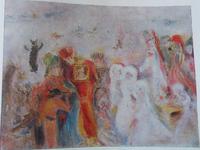
Beati pauperes... Beati mites ... Beati (Psalms 1:1)
Dettagli
Analisi esperta di Beati pauperes... Beati mites ... Beati (Psalms 1:1) di Salvador Dali
Stile: Expressionism, Symbolism · Genere: religious painting
Although the factual details provided are limited, we can still derive a meaningful analysis of Salvador Dalí’s “Beati pauperes... Beati mites ... Beati (Psalms 1:1)” by situating it within his Classic Period (1941–1989) and its declared styles of Expressionism and Symbolism.
Artwork Significance:
This painting marks Dalí’s departure from the purely irrational, dreamlike imagery of his Surrealist years into a more structured, spiritually charged phase—often called his “Classic” or “Mystical” period. The title directly quotes the Beatitudes from the Gospel of Matthew (“Blessed are the poor in spirit… Blessed are the meek…”) and cross-references Psalm 1, merging Old and New Testament sources. This layered biblical reference is typical of Dalí’s symbolic method: he uses recognizable religious texts as a springboard for personal, often paradoxical visual interpretation.
Why It Matters:
-
Merging Expressionism and Symbolism in Religious Art
Dalí applies Expressionist techniques—distorted forms, heightened emotional intensity, and a dramatic, almost violent handling of color or line—to convey the spiritual ecstasy and suffering of the Beatitudes. Simultaneously, the Symbolist approach imbues every element (figures, objects, background) with hidden meaning, inviting the viewer to decode a personal theology. This duality makes the work a bridge between intense emotional experience and intellectual allegory. -
Dalí’s “Classic Period” Reinvention
After his expulsion from the Surrealist movement in the late 1930s, Dalí reinvented himself as a religious traditionalist who still employed avant-garde techniques. Paintings like this one demonstrate his ambition to revitalize religious painting by injecting it with modern psychological depth, while also referencing Renaissance masters (e.g., Raphael, Michelangelo) in composition. The result is a fusion of old and new that challenges the viewer to see scripture through a 20th-century lens. -
Symbolic Complexity and Thematic Tension
The very title juxtaposes the paradoxical joy of poverty, meekness, and mourning (“Beati”) with the stern moral beginning of Psalm 1 (“Blessed is the man who walks not in the counsel of the wicked”). Dalí likely contrasts divine promise with human frailty. In his signature style, he might have inserted ambiguous, even disturbing symbolic details (e.g., floating crutches, distorted landscapes, or dual-faced figures) that force a reexamination of what “blessedness” truly means.
In summary, “Beati pauperes...” is significant as a key example of Dalí’s Classic Period—a time when he harnessed Expressionist emotional force and Symbolist layered meaning to create religious works that are both deeply personal and universally provocative, questioning the nature of sanctity through the lens of a modern, restless imagination.
Genere
Visivamente simili
20 opere con composizione e palette affini
Mariae annunciato (Luke 1:26f)
Salvador Dali
Sponsabo te mihi in sempiternum (Song of Songs 2:12)
Salvador Dali
Iesu nativitas (Matthew 1:20)
Salvador Dali
Lamentation
Albert Bloch
The sacrifice of Isaac
Marc Chagall
Rilke: The Duino Elegies
Maria Bozoky
Ecce virgo concipiet (Isaiah 7:14)
Salvador Dali
Jeremiah received Gift of the prophecy (Jeremiah, I, 4 10)
Marc Chagall
Figures on Dark Ground
Albert Bloch
Manoah and his wife, offering a sacrifice, saw the angel of the Lord flying in the flame (Judges, XIII, 17-23)
Marc Chagall
Pantocrator
Ervin Tamas
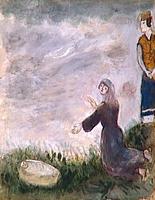
Moses is saved from the water by Pharaoh's daughter
Marc Chagall
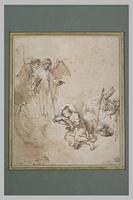
Jacob's Dream
Rembrandt
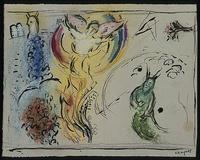
Moses with the Burning Bush
Marc Chagall
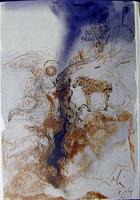
Hircus caprarum super faciem terrae
Salvador Dali
From the Water And The Mystic
Paul F. Yount
Ruth gleaning
Marc Chagall
Moses received the Tablets of Law
Marc Chagall
Rainbow in the sky, a sign of Covenant between God and Earth
Marc Chagall
Suite
Margareta Sterian