Planctus David in mortem Saul
Details
Expertenanalyse zu Salvador Dalis Planctus David in mortem Saul
Stil: Abstract Expressionism, Symbolism · Genre: religious painting
Expert Analysis: "Planctus David in mortem Saul" (c. 1950s)
Salvador Dalí’s Planctus David in mortem Saul represents a fascinating convergence of his late-career religious mysticism with an unexpected engagement with Abstract Expressionism—a movement he publicly both admired and critiqued. While Dalí is synonymous with Surrealism, this work situates itself within his Classic Period (1941–1989), a phase marked by a return to traditional techniques, Catholic iconography, and a personal synthesis of science, religion, and art history.
Significance Within Style and Period
-
Abstract Expressionist Language, Symbolist Intent:
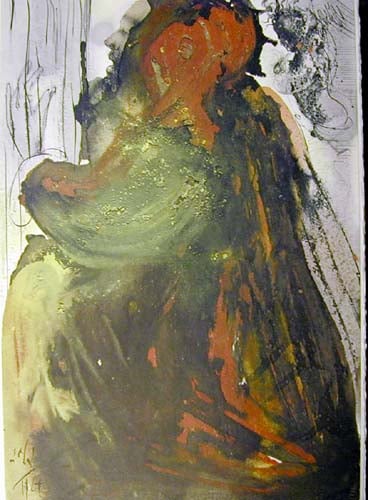
Dalí rarely painted in a purely gestural, non-representational manner, but here he adopts the energetic brushwork and spontaneous color fields that recall the New York School—most notably the “all-over” compositions of Jackson Pollock or the chromatic violence of Willem de Kooning. Yet Dalí never abandons narrative. The abstract passages function as symbolic atmospheres: swirling reds and blacks evoke the battlefield chaos of Gilboa, while a ghostly, half-dissolved figure of David (emerging from the paint) mourns the fallen Saul and Jonathan. This fusion of abstract expressionist technique with symbolist meaning is a deliberate, critical move—Dalí subverts the movement’s emphasis on pure emotion by anchoring it in biblical allegory. -
Religious Painting Reconceived:
The title—Latin for “David’s Lament over the Death of Saul”—references 2 Samuel 1:17–27. Dalí treats the subject not as a narrative tableau but as a spiritual implosion. The “planctus” (lament) becomes a visual scream, the paint itself acting as the keening. This is significant for its era: at a time when many avant-garde artists rejected organized religion, Dalí insisted that the most modern means (abstract gesture) could serve the most ancient ends (theology). The work prefigures his later “Nuclear Mysticism,” where he painted religious themes through quantum mechanics and the golden ratio. -
The Classic Period’s Hybridity:
From the 1940s onward, Dalí called his style “Classic” to signal a mastery of Renaissance draftsmanship combined with modern dislocation. In Planctus David, this manifests in the tension between the almost abstract background and a few meticulously rendered details—perhaps the harp of David or the crown of Saul—that anchor the composition in recognizable sacred history. The painting thus becomes a test case for Dalí’s late theory: that the greatest art must reconcile the irrational energy of the modern with the ordered beauty of the past.
Analysis of Visual Elements
- Composition: A vertical, tormented structure. Diagonal slashes of impasto collide with softer, fog-like washes. A central, vaguely anthropomorphic shape (David) tilts backward, arms outstretched, while dark clouds of paint climb from the lower edge. The overall effect is of a storm seen through tears.
- Color: Dominated by ochre, umber, and deep crimson—the palette of blood, earth, and faded royal purple. A rare streak of gold (the remnant of Saul’s armor?) cuts through the left side, a flicker of divine light amidst mourning.
- Symbolism: The abstract skeins may also represent the literal “wound” of grief. Dalí often used dripping paint to suggest tears or blood, and here the physical texture of the canvas becomes a reliquary of sorrow.
Why It Matters
Planctus David in mortem Saul is significant because it challenges the binary between figuration and abstraction, sacred and secular, European tradition and American novelty. It shows Dalí not as a static surrealist but as a restless experimenter who, in his later years, absorbed and transformed the most radical painting of his time to serve a timeless spiritual purpose. For the viewer, it offers a rare glimpse of Abstract Expressionism filtered through the lens of Renaissance iconography—a dialogue that few artists dared to stage.
Visuell ähnlich
20 Werke mit ähnlicher Komposition und Farbpalette
Silueta
Lilia Carrillo
Child in Black
Egon Schiele
Varinas
Luis Dourdil
Bela Adalbert Czobel Young Girl
Bela Czobel
Anna Margit, Női Portré 1943
Anna Margit
Untitled
Nicolas Carone
Pregnant woman and Death
Egon Schiele
Noli me tangere (John 20:1)
Salvador Dali
Trance Mit Jäger
Werner Berg
Sedet sola civitas plena populo (Lamentations 1:1)
Salvador Dali
Thought
Nemanja Vučković
Hiroshima Child
Karel Appel
Celestina con carne
José Luis Cuevas
Blue Woman
Eugene Leroy
A Figure
Odilon Redon
Female Figure
Giovanni Boldini
Ecce virgo concipiet (Isaiah 7:14)
Salvador Dali
Figures at the Japan Sea
George Stefanescu
Prophet and angel
Marc Chagall
Waterfall
Arshile Gorky