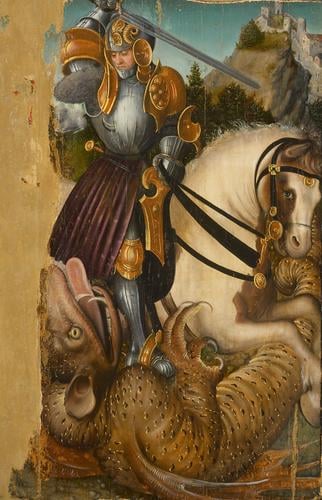
Expert analysis of Lucas Cranach the Elder’s St. George with head of the dragon
Style: Northern Renaissance · Genre: religious painting
Expert Art Historical Analysis:
"St. George with head of the dragon" by Lucas Cranach the Elder stands as a compelling example of Northern Renaissance religious painting, distinguished by its fusion of meticulous naturalism with symbolic elegance. Cranach, a leading court painter to Frederick the Wise of Saxony and a close associate of Martin Luther, brought a distinctive vocabulary to traditional hagiographic subjects.
Significance within the Northern Renaissance:
- Mannerist-Elegance: Unlike earlier, more austere depictions, Cranach endows St. George with an elongated, almost sinuous physique—a hallmark of his mature style. The saint’s poised, courtly gesture of holding the severed dragon’s head shifts the emphasis from violent combat to triumphant refinement, aligning with the Northern Renaissance's growing interest in idealized, graceful human forms.
- Symbolic Naturalism: Every texture—the shimmer of armor, the scaly hide of the dragon, the atmospheric landscape—is rendered with precise, almost miniaturist detail typical of Northern art. Yet these elements serve a symbolic purpose: the dragon’s head not only signifies evil vanquished but becomes a trophy of faith, reinforcing the painting's religious narrative while showcasing Cranach’s technical mastery.
- Reformist Undertones: Painted during the early Reformation, Cranach’s St. George may subtly reflect Lutheran themes of direct spiritual struggle and the role of the individual believer. The saint’s calm, aristocratic demeanor suggests a victory attained through grace rather than brute force, a nuanced interpretation that places this work at the crossroads of religious tradition and evolving Protestant sensibilities.
What Makes It Noteworthy: Cranach’s treatment is at once intimate and iconic: the saint’s cool gaze and the dragon’s grotesque yet stylized head create a tension between horror and beauty. This duality—along with the painting’s vibrant palette, delicate landscape backdrop, and the artist’s signature use of slender, decorative forms—cements the work as a pivotal instance of how Northern Renaissance artists transformed medieval religious iconography into a vehicle for personal, courtly, and doctrinal expression.
Museum / Gallery
Visually similar
20 works with related composition and palette
Saint George and the Dragon
Rogier van der Weyden
Saint George
Carlo Crivelli
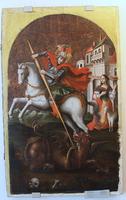
Saint George
Yov Kondzelevych
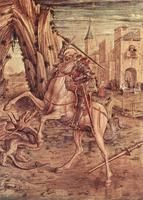
Saint George and the dragon
Carlo Crivelli
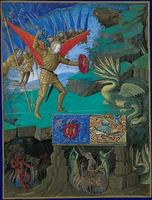
St. Michael slaying the dragon
Jean Fouquet
Constantine's Victory over Maxentius (detail)
Piero della Francesca
Saint Paul
Jean Fouquet
St. George Killing the Dragon
Vittore Carpaccio
Saint Michael Triumphs over the Devil
Bartolome Bermejo
Allegory of March – Triumph of Minerva and Sign of Aries. Frescos in Palazzo Schifanoia (detail)
Francesco del Cossa
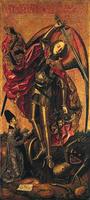
Saint Michael Triumphs over the Devil
Bartolome Bermejo
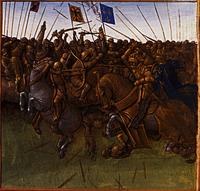
Victory of Louis III and Carloman on the Normans
Jean Fouquet
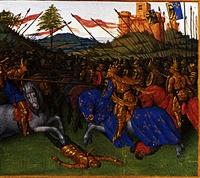
Wars of Charlemagne
Jean Fouquet

The Soldiers of Christ
Jan van Eyck
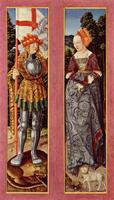
Three king altar
Hans Baldung
Saint George, after Vittore Carpaccio
Gustave Moreau
A re-imagination of Louis III and Carloman's 879 victory over the vikings
Jean Fouquet
St. George and the Dragon
Raphael
St. George and the Dragon
Raphael
David's Victory
Limbourg brothers