Analisi esperta di Stories of St Barbara di Lorenzo Lotto
Stile: High Renaissance · Genere: religious painting
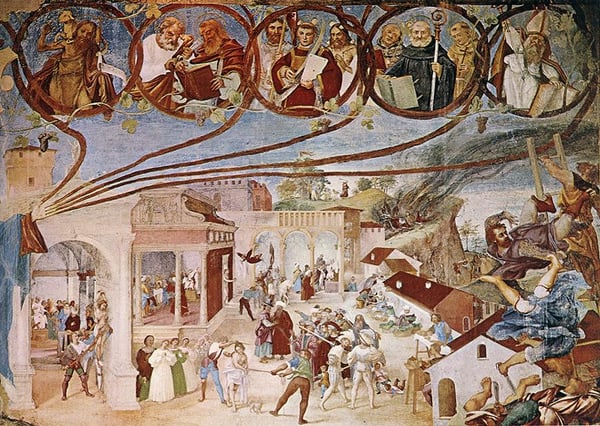
Lorenzo Lotto's Stories of St. Barbara stands as a compelling example of the High Renaissance religious narrative, yet it reveals the artist’s singular deviation from the period’s more serene ideals. While High Renaissance painting often sought idealized harmony, balanced composition, and monumental figures (as seen in Raphael or Leonardo), Lotto infuses this sacred story with a palpable psychological tension and intimate, almost theatrical detail.
Significance within the High Renaissance:
-
Narrative innovation: Lotto does not depict a single sacred scene but rather a sequence of episodes from St. Barbara’s life. This polyptych-like structure—common in altarpieces—is reimagined with a unifying landscape or architectural backdrop that guides the viewer’s eye across multiple moments, from her confinement to her martyrdom. This approach reflects the High Renaissance interest in istoria (storytelling), but Lotto’s version feels more episodic and emotionally immediate than the grand, unified compositions of his contemporaries.
-
Emotional and psychological depth: St. Barbara’s story—a Christian saint executed by her own father for her faith—is rendered with an almost neurotic intensity. Lotto’s figures often display anxious, sidelong glances or dramatic gestures, breaking the serene composure typical of High Renaissance saints. This psychological realism anticipates Mannerism and hints at the artist’s personal, introspective style.
-
Color and light as narrative tools: Lotto employs a vibrant, sometimes idiosyncratic palette—sharp greens, luminous blues, and warm ochres—that diverges from the more subdued sfumato of Leonardo or the balanced Venetian color of Titian. In Stories of St. Barbara, light falls unevenly, spotlighting key moments and creating a sense of precarious drama, rather than the even, divine illumination seen in works by Perugino or Raphael.
-
Marginal figures and architectural details: Lotto devotes attention to secondary characters and everyday elements—a ladder, a tower, a hurried attendant—that ground the divine narrative in a recognizable, human world. This attention to the circumstantial was a hallmark of his work, offering a counterpoint to the idealized landscapes of his peers.
In sum, Lorenzo Lotto’s Stories of St. Barbara is significant as a High Renaissance religious painting that exemplifies the period’s narrative ambition while simultaneously challenging its dominant aesthetics. It reveals an artist more interested in emotional tension, psychological complexity, and idiosyncratic detail than in classical balance—a personal vision that enriches our understanding of the High Renaissance’s diverse possibilities.
Visivamente simili
20 opere con composizione e palette affini
St. Francis Giving Away His Clothes, Vision of the Church Militant and Triumphant (detail)
Benozzo Gozzoli
The Legend of St. Barbara.
Lorenzo Lotto
Martyrdom of the Carmelites
Jerg Ratgeb
Allegory of March – Triumph of Minerva and Sign of Aries. Frescos in Palazzo Schifanoia (detail)
Francesco del Cossa
Disputation in the Synagogue
Filippo Lippi
Life of St. Benedict. Benedict Discovers Totila's Deceit
Luca Signorelli
Meeting of Duke Ludovico II Gonzaga with Cardinal Francesco Gonz (fragment)
Andrea Mantegna
The School of Tagaste
Benozzo Gozzoli
Allegory of March – Triumph of Minerva and Sign of Aries. Frescos in Palazzo Schifanoia (detail)
Francesco del Cossa
Life of St Benedict, Scene 30. Benedict Foretells the Destruction of Montecassino
Il Sodoma
Sinking Of The Pharaoh In The Red Sea
Lucas Cranach the Elder
Stoning of St.Stephen
Paolo Uccello
Paintings for the Armadio degli Argenti
Fra Angelico
April. Fresco in Palazzo Schifanoia
Francesco del Cossa
The Birth and Infancy of St. Stephen
Filippo Lippi
April. Fresco in Palazzo Schifanoia (detail)
Francesco del Cossa
Disembarkation at Ostia
Benozzo Gozzoli
Battle between Heraclius and Chosroes
Piero della Francesca
Procession of the Magi (detail)
Benozzo Gozzoli
The Passion
Hans Memling